
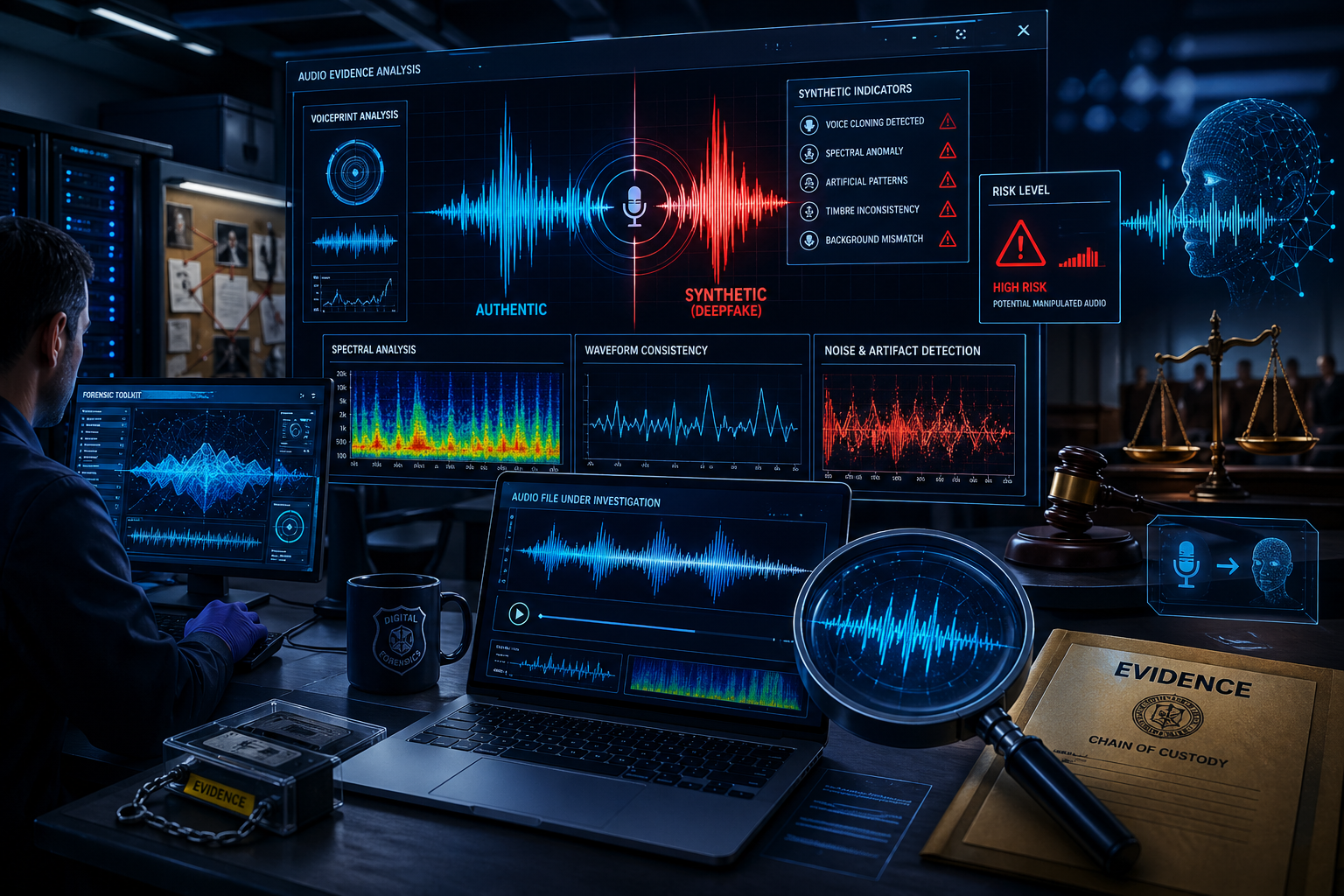
Audio Deepfakes in Digital Forensics: Risks, Detection, and Best Practices
In an era where artificial intelligence can replicate any individual's voice with remarkable precision, audio deepfakespose a significant threat to the integrity of criminal investigations. Forensic laboratories can no longer rely unquestioningly on every audio recording. Examine the processes by which these audio deepfakes are created, the substantial risks they present, the inherent challenges in their deepfake detection, and advanced solutions. Acquire essential best practices and strategic approaches to maintain a competitive edge, thereby guaranteeing the admissibility and reliability of evidence in judicial proceedings.
What Are Audio Deepfakes?
Audio deepfakes represent a sophisticated application of deepfake technology, where artificial intelligence, particularly machine learning models like text-to-speech systems, replicates real human voices with startling accuracy, posing significant challenges for digital forensics and voice authentication processes in forensic labs.
These AI-generated audio manipulations, often indistinguishable from genuine recordings, leverage advanced neural networks to synthesize speech patterns, intonations, and nuances, making them potent tools for voice phishing, impersonation fraud, and disinformation campaigns that undermine trust in multimedia evidence.
As forensic imaging and signal processing techniques evolve, understanding audio deepfakes is crucial for maintaining the integrity of investigations reliant on audio evidence verification. For instance, a text-to-speech system might clone a CEO's voice to authorize fake transactions in impersonation fraud.
Forensic labs face heightened risks from disinformation spread via manipulated podcasts or calls, demanding robust deepfake detection methods. Experts recommend integrating spectral analysis early in workflows to spot anomalies in audio deepfakes.
How Do Audio Deepfakes Work?
Audio deepfakes work by employing deepfake technology powered by machine learning algorithms to analyze and replicate voice characteristics from source audio samples.
Models train on large datasets, extracting features like mfcc and lfcc to capture timbre and pitch. This process reveals dataset biases and adversarial vulnerabilities, where slight alterations fool voice authentication systems.
Text-to-speech synthesis combines with multimodal approaches, blending audio with visual data for realistic output. For example, generating a politician's speech for disinformation involves fine-tuning models on hours of target voice data.
Generation exposes noise sensitivity, as real-world echoes challenge synthetic audio. Labs follow structured evaluation approaches for reliable signal processing.
Why Do Audio Deepfakes Matter for Digital Forensic Labs?
Audio deepfakes are critically important for digital forensic labs because they threaten the reliability of audio evidence in investigations, necessitating advanced deepfake detection and forensic readiness protocols to combat voice phishing, impersonation fraud, and disinformation spread through manipulated multimedia artifacts.
In an era where AI-driven audio deepfakes can fabricate convincing testimonials or confessions, labs must integrate robust verification workflows involving spectral analysis and behavioral biometrics to ensure evidentiary integrity amid rising forensic demands.
This underscores the need for digital forensics experts to adapt to these threats, protecting judicial processes from adversarial vulnerabilities inherent in such synthetic media. For instance, a forged audio clip mimicking a suspect's voice could sway trial outcomes if not scrutinized properly.
Labs should prioritize forensic readiness by training staff on machine learning models, which help detect subtle artifacts in text-to-speech generated fakes. This preparation fortifies defenses against evolving deepfake technology.
What Are the Risks of Undetected Audio Deepfakes in Investigations?
Undetected audio deepfakes in investigations pose severe risks, including enabling voice phishing scams, impersonation fraud, and widespread disinformation that can derail legal proceedings.
In forensic environments, a deepfake audio call impersonating an executive might trick investigators into pursuing false leads, exploiting weaknesses in detection models trained on limited datasets. These biases allow adversaries to craft audio evading standard voice authentication checks.
Adversarial vulnerabilities amplify dangers in high-stakes cases, such as when manipulated clips spread disinformation via virtual assistants or IoT devices, complicating investigations.
Experts recommend combining spectral analysis with behavioral biometrics to spot inconsistencies like unnatural noise sensitivity.
Practical steps include routine hashing and cryptographic analysis for chain-of-custody verification, alongside multimodal approaches that cross-check audio with other evidence sources.
How Are Audio Deepfakes Created?
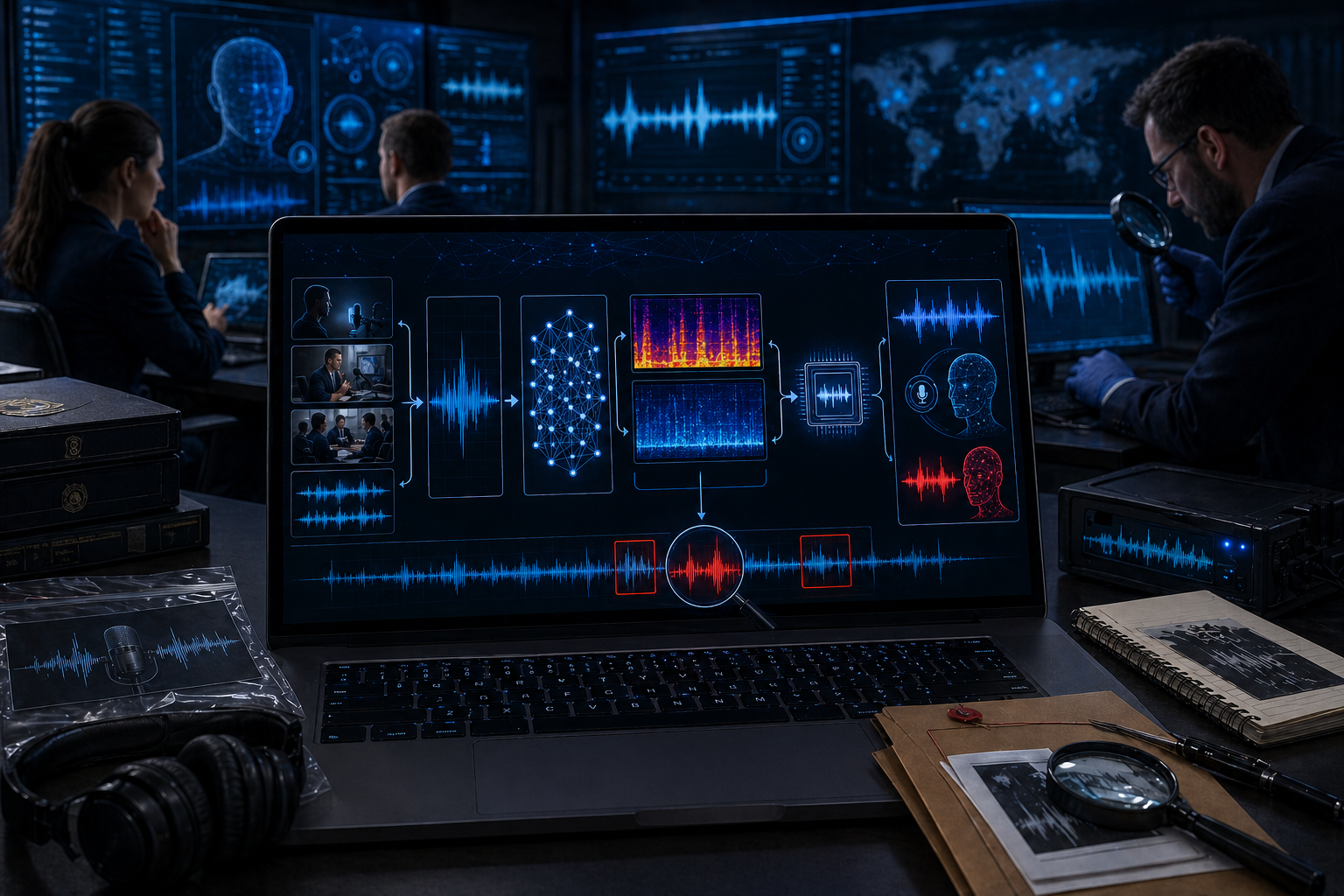
Audio deepfakes are created using deepfake technology that harnesses machine learning and text-to-speech systems to generate synthetic voices through advanced signal processing techniques.
The process starts with data collection. Creators gather hours of target voice samples, such as podcasts or interviews, to capture unique speech patterns. This raw audio feeds into models that learn vocal traits like pitch and timbre.
Next comes model training using advanced architectures. These systems analyze features like MFCC and LFCC for spectral analysis.
Finally, text-to-speech synthesis generates the fake audio. Understanding this pipeline aids deepfake detection by spotting artifacts in the waveform.
What Are the Challenges in Detecting Audio Deepfakes?
detecting audio deepfakes presents formidable challenges due to their high fidelity, exacerbated by dataset biases, adversarial vulnerabilities, and noise sensitivity that complicate features like MFCC and LFCC in analysis pipelines.
Feature extraction methods may be distorted in real-world recordings. For example, background sounds in voice phishing calls can mask deepfake artifacts. Labs need robust preprocessing to counter this.
Dataset limitations reduce model generalization. Models trained on clean data fail in diverse environments.
Adversarial manipulation allows attackers to tweak audio and evade detection systems, requiring continuous updates. Multimodal approaches combining audio with other data help, but challenges persist in impersonation fraud cases.
Can Audio Deepfakes Fool Traditional Forensic Methods?
Yes, audio deepfakes can often fool traditional forensic methods such as spectral analysis, hashing, cryptographic analysis, and forensic linguistics due to their ability to mimic authentic audio artifacts.
These tools work well for unaltered files, but deepfakes can bypass them. Digital forensics teams face gaps here.
Spectral analysis and signal processing check for inconsistencies, yet text-to-speech models replicate natural patterns. In disinformation campaigns, forged speeches can pass these checks.
Hashing verifies file integrity, but edited deepfakes generate new hashes matching originals. Cryptographic analysis struggles against synthetic manipulations.
Mobile, network, cloud, and IoT forensics provide tracing, yet advanced deepfakes continue to evolve beyond these methods.
Best Practices for Audio Deepfake Detection in Forensic Labs
Best practices for audio deepfake detection in forensic labs include establishing forensic readiness, combining behavioral biometrics with multiple forensic disciplines to verify evidence integrity.
Forensic readiness involves preparing systems to capture and preserve audio evidence reliably. Teams train on spectral analysis and signal processing to spot anomalies in recordings.
Combining machine learning models with traditional methods strengthens detection. Multimodal approaches reduce risks from dataset biases and adversarial manipulation.
Key practices include:
- Implement hashing and cryptographic verification
- Use MFCC and LFCC features for initial examination
- Integrate behavioral biometrics for speaker validation
What Is the Future of Audio Deepfake Detection?
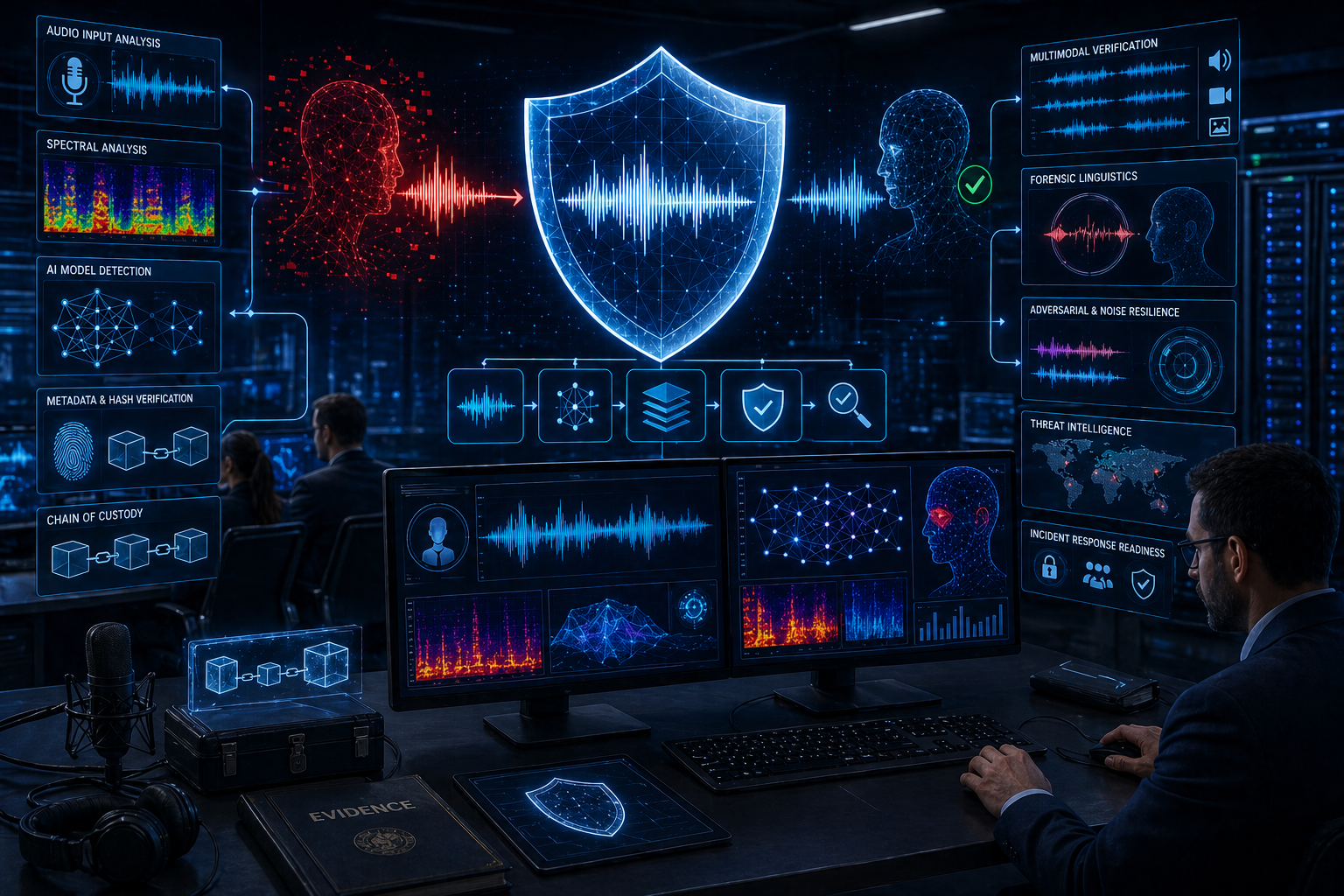
The future of audio deepfake detection lies in advancing machine learning with multimodal approaches to counter evolving threats more effectively.
Emerging trends focus on advanced architectures to analyze features like MFCC and LFCC in spectral analysis. These methods address dataset biases, adversarial vulnerabilities, and noise sensitivity.
Multimodal approaches integrate audio with other data, countering threats like voice phishing and impersonation fraud.
Future research emphasizes standardized evaluation and improved resilience against evolving deepfake techniques.
How Can Forensic Labs Stay Ahead of AI-Generated Audio Threats?
Forensic labs can stay ahead of AI-generated audio threats by enhancing forensic readiness and adopting structured investigative protocols.
Build digital forensic capabilities with proactive imaging, hashing, and cryptographic analysis. Integrate multiple forensic domains to trace audio deepfakes.
Establish forensic readiness plans that log identifiers for rapid incident response.
Adopt multimodal approaches combining spectral analysis with forensic linguistics. Regular drills ensure readiness for voice phishing and disinformation.
Audio deepfakes have rapidly evolved into a serious threat for digital forensic investigations, challenging the authenticity of audio evidence used in legal and intelligence workflows. With AI capable of replicating human voices with high accuracy, traditional verification methods alone are no longer sufficient. From voice phishing and impersonation fraud to disinformation campaigns, the risks of undetected synthetic audio can significantly impact investigative outcomes.
To address these challenges, forensic labs must adopt advanced detection strategies that combine spectral analysis, behavioral biometrics, and multimodal validation across different forensic domains. Strengthening forensic readiness, improving analytical workflows, and continuously adapting to evolving adversarial techniques are now critical to ensuring the integrity and admissibility of audio evidence.
As these threats continue to grow in complexity, platforms like platforms like PaladinAi’s DeepGaze provide forensic-grade capabilities to identify and analyze manipulated audio with high accuracy, enabling investigators to make confident, evidence-backed decisions in high-stakes environments.
Frequently Asked Questions
Ready to experience & accerlate your Investigations?
Experience the speed, simplicity, and power of our AI-powered Investiagtion platform.
Tell us a bit about your environment & requirements, and we’ll set up a demo to showcase our technology.