
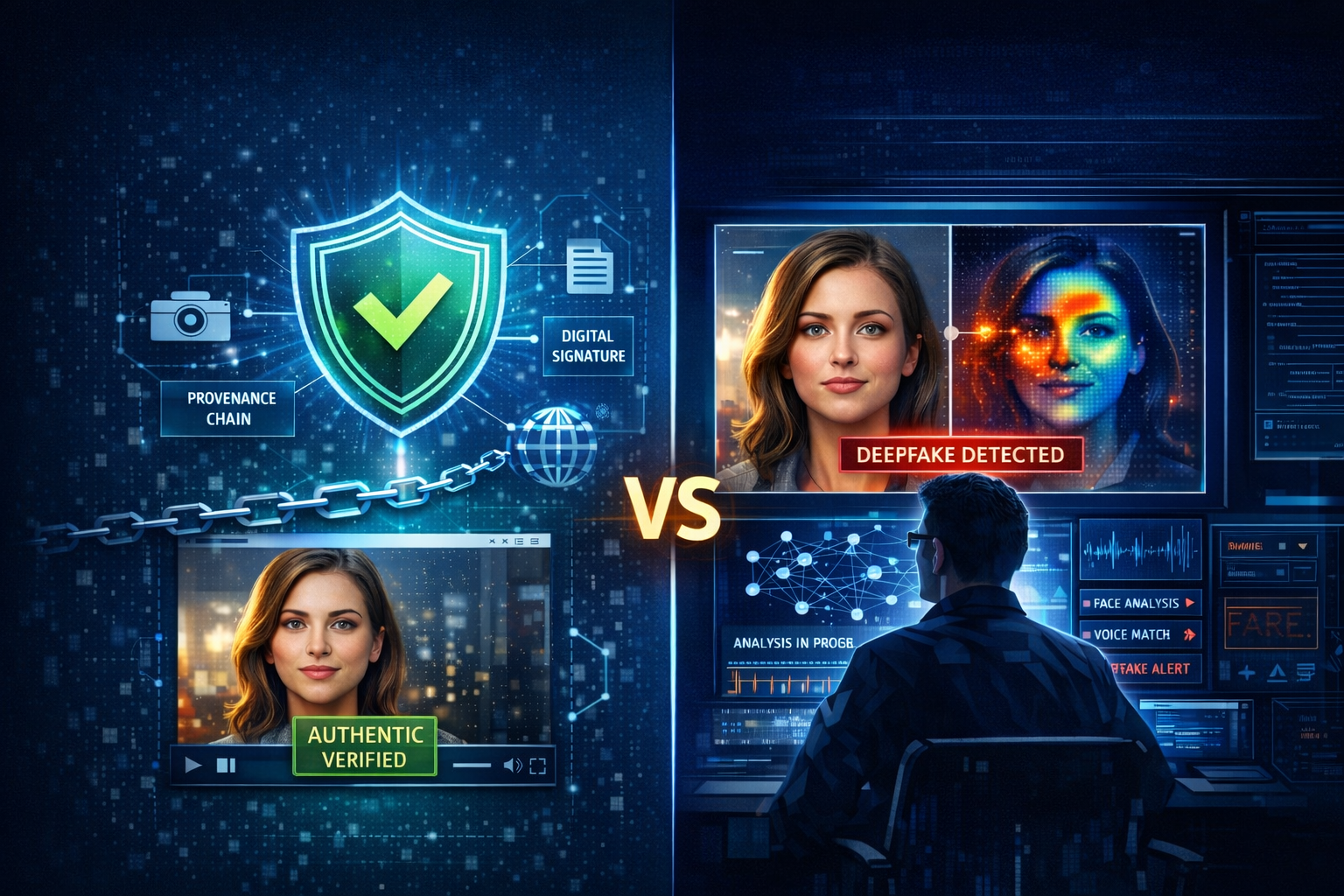
C2PA vs Deepfake Detection: Why Content Provenance Alone Cannot Stop Synthetic Media
Artificial intelligence has transformed how digital content is created, edited, and distributed. From AI-generated images and synthetic voices to hyper-realistic deepfake videos, generative AI technologies are now capable of producing content that can be nearly indistinguishable from reality. While these innovations bring significant benefits across industries such as media production, marketing, and entertainment, they also introduce serious risks related to misinformation, fraud, identity manipulation, and digital evidence tampering.
The rapid growth of synthetic media has made media authenticity verification one of the most urgent cybersecurity and digital forensics challenges today. Governments, financial institutions, media organizations, and law enforcement agencies are now actively searching for reliable solutions that can help determine whether digital content is authentic or artificially generated.
Two major approaches have emerged in this space:
- C2PA (Coalition for Content Provenance and Authenticity) - a standard designed to track the origin and modification history of digital content.
- Deepfake Detection Technologies - AI-driven forensic tools that analyze digital media to determine whether it has been manipulated or synthetically generated.
While both technologies aim to strengthen trust in digital media, they solve very different problems. Understanding the difference between C2PA vs deepfake detection is essential for organizations that rely on digital evidence, investigative intelligence, or public information integrity.
This article explores how these technologies work, where they succeed, where they fall short, and why deepfake detection remains a critical layer in modern media verification frameworks.
The Growing Threat of Synthetic Media
Before comparing the technologies, it is important to understand why media authenticity has become such a pressing issue.
Deepfake technology uses machine learning models-often Generative Adversarial Networks (GANs) or diffusion models-to generate realistic visual and audio content. These models can recreate human faces, voices, and environments with remarkable accuracy.
The consequences are already visible across multiple sectors.
Deepfake videos have been used to spread political misinformation, manipulate public narratives, and impersonate public figures. Voice cloning technologies have been used in financial fraud schemes, where attackers mimic executives to authorize fraudulent payments. Synthetic media is also increasingly appearing in disinformation campaigns during geopolitical conflicts, where fabricated footage spreads rapidly across social media platforms.
In the context of digital forensics, synthetic media presents an even more complex problem. Investigators must now determine whether images or videos submitted as evidence are authentic or manipulated. Traditional methods of verifying digital media -such as metadata analysis-are no longer sufficient because modern deepfakes often remove or alter such data.
As a result, organizations are exploring technologies that can help validate the authenticity of digital content. This is where C2PA standards and deepfake detection systems enter the conversation.
What is C2PA?
C2PA (Coalition for Content Provenance and Authenticity) is an open technical standard designed to provide transparency about how digital media was created and modified.
The initiative was developed through collaboration between major technology organizations, including Adobe, Microsoft, Intel, BBC, and Truepic. The goal is to create a universal framework that allows media creators to attach content credentials to digital files.
These credentials contain a secure record of the content’s history.
How C2PA Works
When media is created using C2PA-compatible tools or platforms, the system attaches a cryptographically signed metadata record to the file. This record documents the provenance of the content.
Typical information stored within C2PA metadata includes:
- The creator or capture device
- The editing software used
- A timeline of modifications
- Timestamps of edits
- Digital signatures verifying authenticity
This metadata creates a chain of trust that tracks the lifecycle of digital content from creation to distribution.
For example, a photo taken by a camera with C2PA support could contain credentials indicating:
- The camera model used
- The date and time the photo was captured
- Any editing performed in software
- Export details before publishing
When someone views the file later, they can inspect these credentials to see how the media was produced.
The Goal of Content Provenance
The primary purpose of C2PA is transparency.
By providing visibility into the creation process, the standard aims to help people determine whether content originated from trusted sources.
For example, media organizations could use C2PA to verify that a photograph published by a newsroom has not been altered in misleading ways. Social platforms could display content credentials to show the history of uploaded media.
The system attempts to build a trust framework for digital media ecosystems.
However, while this approach improves transparency, it does not fully address the broader challenge of synthetic media.
The Limitations of C2PA
Despite its promise, C2PA has important limitations when dealing with deepfakes.
The most significant limitation is that C2PA does not detect manipulated media. Instead, it only verifies whether metadata exists and whether it has been tampered with.
If a file does not contain valid C2PA metadata, the system cannot determine whether the content is authentic or synthetic.
This creates several challenges.
First, most deepfakes are generated outside controlled content creation environments. Attackers typically use independent AI tools that do not embed C2PA credentials.
Second, metadata can be removed easily when files are uploaded, downloaded, or re-encoded on social platforms. Even legitimate media often loses metadata during normal distribution processes.
Third, malicious actors can intentionally strip or modify metadata before releasing manipulated media.
As a result, many pieces of content circulating online simply lack provenance data entirely.
In such cases, C2PA cannot determine whether the media is authentic.
What is Deepfake Detection?
Deepfake detection technologies address the authenticity problem from a different perspective.
Instead of relying on metadata or provenance records, deepfake detection systems analyze the actual content of the media itself.
These technologies apply forensic grade AI analysis to identify signals that indicate whether a piece of media was artificially generated or manipulated.
The analysis may involve examining:
- Facial structure inconsistencies
- Abnormal blinking patterns
- Lighting and shadow mismatches
- Pixel-level artifacts introduced by generative models
- Compression patterns
- Audio waveform anomalies
- Lip-sync inconsistencies
- AI generation fingerprints
By analyzing these signals, deepfake detection systems can determine whether a video, image, or audio file contains signs of synthetic generation.
How Modern Deepfake Detection Works
Modern deepfake detection platforms combine multiple analytical methods to evaluate digital media.
1. AI Model Artifact Detection
Generative AI models often leave subtle patterns within the pixels of images and frames of videos. Detection models are trained to recognize these artifacts.
2. Facial Biometric Analysis
Deepfake detection systems examine facial geometry, expressions, and motion patterns to identify unnatural behavior.
3. Temporal Consistency Analysis
In videos, synthetic generation often produces inconsistencies across frames. Temporal analysis helps identify unnatural motion or transitions.
4. Audio Signal Analysis
Voice cloning systems generate audio patterns that differ from natural speech in terms of frequency distribution and waveform structures.
5. Cross-Modal Analysis
Some systems compare audio and video signals to identify mismatches between lip movement and speech patterns.
These forensic techniques allow detection systems to evaluate media even when metadata is missing or altered.
C2PA vs Deepfake Detection: Key Differences
The differences between C2PA and deepfake detection can be summarized across several dimensions.
| Feature | C2PA | Deepfake Detection |
|---|---|---|
| Primary goal | Track content provenance | Identify manipulated media |
| Verification method | Metadata validation | AI forensic analysis |
| Works without metadata | No | Yes |
| Detects AI-generated media | No | Yes |
| Suitable for investigations | Limited | Strong |
| Protection against manipulated content | Indirect | Direct |
C2PA provides transparency about trusted content creation, while deepfake detection determines whether unknown content is authentic or synthetic.
Both technologies operate in different stages of the media lifecycle.
Real-World Scenarios Where C2PA Fails
To understand the practical implications, consider common real-world scenarios.
Viral Social Media Videos
A video circulates widely on social media claiming to show a military strike or major public event. The video has been downloaded and re-uploaded thousands of times.
The file has no provenance metadata.
C2PA cannot determine its authenticity.
Deepfake detection systems can analyze the visual signals to determine whether the video is synthetic.
Financial Fraud and Voice Cloning
In several reported fraud cases, attackers used AI voice cloning tools to impersonate company executives and request urgent financial transfers.
The audio recordings contained no provenance credentials.
Detection systems analyzing waveform patterns were required to identify synthetic speech.
Criminal Investigations
Digital forensic investigators often encounter media files submitted as evidence.
These files may originate from unknown sources and lack reliable metadata.
Deepfake detection technologies are essential for evaluating such evidence.
Why Deepfake Detection Is Essential for Digital Forensics
Digital forensics laboratories increasingly face cases involving manipulated media.
Investigators need tools that can determine whether a file:
- Has been artificially generated
- Has been manipulated or edited
- Contains synthetic audio or visuals
Since provenance metadata is often absent, forensic analysis must rely on content-based verification.
Deepfake detection technologies allow investigators to analyze evidence even when the original creation history is unavailable.
This capability is particularly important in cases involving:
- Cybercrime investigations
- Financial fraud
- Disinformation campaigns
- Evidence validation in court proceedings
- National security investigations
The Future of Media Verification: A Layered Approach
Rather than viewing C2PA and deepfake detection as competing solutions, experts increasingly recognize that they address different layers of media authenticity.
C2PA works best in trusted content creation environments, where creators and platforms adopt provenance standards.
Deepfake detection works best when analyzing untrusted or unknown media sources.
A comprehensive media verification strategy will combine both approaches.
For example:
- C2PA ensures trusted content carries verifiable provenance credentials.
Deepfake detection analyzes suspicious content circulating outside controlled environments.
Together, these systems create a stronger framework for digital media verification.
The Role of AI Forensic Platforms
As synthetic media becomes more sophisticated, specialized forensic platforms are emerging to support large-scale authenticity analysis.
Platforms such as PaladinAi DeepGaze are designed to analyze digital media across multiple formats, including:
- Deepfake videos
- AI-generated images
- Voice cloning
- Manipulated multimedia content
These systems apply forensic AI models to identify patterns associated with synthetic generation.
Such platforms are increasingly used by:
- Law enforcement agencies
- Financial institutions
- cybersecurity teams
- media verification units
- digital forensic laboratories
By combining automated detection with investigative analysis tools, these platforms help organizations evaluate the authenticity of digital evidence more efficiently.
The Importance of Digital Trust Infrastructure
The spread of synthetic media highlights a broader issue: trust in digital information is becoming increasingly fragile.
When people can no longer rely on the authenticity of images, videos, or audio recordings, the consequences extend beyond cybersecurity.
Public discourse, journalism, financial markets, and national security can all be affected by manipulated media.
Building resilient digital trust infrastructure will require a combination of technologies including:
- Content provenance standards
- forensic AI analysis
- secure data chains
- investigative verification systems
Organizations must adopt tools that allow them to validate digital content with confidence, even in environments where information spreads rapidly and unpredictably.
Conclusion
The rise of generative AI has fundamentally changed the landscape of digital media. Synthetic videos, voice cloning, and AI-generated images now pose serious risks across multiple industries.
Technologies such as C2PA provide valuable transparency by documenting the creation and modification history of digital content. However, provenance standards alone cannot detect deepfakes or determine whether media is synthetic.
Deepfake detection technologies fill this critical gap by analyzing the actual signals within digital content to identify manipulation or AI generation.
In the future, the most effective media verification strategies will combine both approaches.
Content provenance standards can help establish trust in legitimate media creation processes, while forensic deepfake detection tools ensure that suspicious content can be evaluated independently.
As organizations continue to confront the challenges of synthetic media, combining provenance verification with AI-driven forensic analysis will be essential for maintaining trust in digital information.
Frequently Asked Questions
Ready to experience & accerlate your Investigations?
Experience the speed, simplicity, and power of our AI-powered Investiagtion platform.
Tell us a bit about your environment & requirements, and we’ll set up a demo to showcase our technology.