
Cognitive Warfare Through Repetitive Political Deepfake Campaigns
Political communication is entering a new phase where the question is no longer only whether a message is true, but whether the media carrying that message is authentic. In India, where public discourse is increasingly shaped by short-form video, multilingual audio clips, livestream fragments, regional-language content, and platform-native edits, AI-generated political content can move from limited circulation to national attention within hours.
Recent viral public speeches and political clips in India have triggered wider discussions around authenticity, AI manipulation, and media verification. Even when an original speech is real, misleading actors can create edited versions, AI-generated voiceovers, altered captions, selective cuts, or short clips that distort the intended meaning. This does not mean the original speech is fake. It shows how real public communication can be repackaged, manipulated, or misrepresented to create confusion around what was actually said.
In modern misinformation campaigns, the risk is not limited to fully fabricated deepfakes. It also includes the misuse of real speeches through selective editing, synthetic dubbing, misleading captions, and AI-generated variations. This article examines the broader risk: synthetic and manipulated media can be used repetitively to influence perception, create uncertainty, and weaken trust in digital communication.
For enterprises, government agencies, media organizations, and public institutions, the challenge is clear. Synthetic media verification must become a core capability within digital risk management, much like phishing detection, endpoint monitoring, and brand impersonation defense.
The Rise of Political Deepfakes in India
India is uniquely exposed to political deepfake risk because of its scale, linguistic diversity, social media penetration, and emotionally charged election cycles. Political messaging is no longer limited to rallies, television interviews, or official statements. It now flows through WhatsApp forwards, regional-language reels, meme pages, influencer networks, short video platforms, and hyperlocal political groups.
The issue is not limited to one party, ideology, or leader. Political deepfakes can target public officials, opposition figures, journalists, civil society representatives, media institutions, and public communication channels. A synthetic clip can falsely attribute a statement, distort a policy position, imitate a voice, or create the impression of endorsement or hostility.
In this environment, a modern deepfake detection platform must be treated as part of the wider digital trust stack. For cybersecurity and media teams, the objective is not political interpretation. The objective is evidence-based verification: what was said, when, by whom, through which channel, and whether the media shows signs of manipulation.
Political deepfake detection is especially important in India because of multilingual communication and high-speed digital distribution. A single clip can be subtitled, dubbed, cropped, re-uploaded, and reshared across different communities within a short period. Once a narrative spreads, later correction may not fully reverse its influence.
Viral Political Speeches and the Risk of AI Manipulation
Political speeches are high-value targets for manipulation because they carry authority. A few altered seconds can change perceived intent. A translated or dubbed version can shift meaning. A synthetic voice can create the illusion of direct communication. A clip taken out of context can trigger the same public reaction as a fully fabricated video.
In India, recent viral political speech discussions involving Prime Minister Narendra Modi have highlighted the importance of media verification. Some clips have raised concerns around AI manipulation, while others have involved questions of context, editing, or platform-driven amplification.
The safer and more accurate framing is not to assume every viral clip is synthetic. The correct operational response is to verify before amplification.
For government agencies, media organizations, cybersecurity teams, and researchers, the key question is not whether political content feels believable. The key question is whether it can be authenticated through technical analysis, source validation, metadata review, and contextual verification.
A suspicious political video should be reviewed for:
- Original source and upload trail.
- Event context and date.
- Audio-visual consistency.
- Metadata indicators.
- Caption accuracy.
- Editing or dubbing traces.
- Cross-platform distribution pattern.
- Signs of AI-generated or synthetic media.
Why High-Profile Political Content Spreads Rapidly
High-profile political media spreads quickly because it combines three powerful elements: authority, emotion, and identity. When a video appears to show a senior leader making a controversial statement, audiences are more likely to react immediately, share quickly, and interpret the content through existing political beliefs.
Several factors accelerate this spread:
- Platform velocity: Short-form video platforms reward rapid engagement.
- Network trust: People are more likely to believe content forwarded by friends, family, or community groups.
- Language localization: AI dubbing and voice cloning can adapt content for regional audiences.
- Confirmation bias: Users may accept content that aligns with existing beliefs.
- Low verification friction: Sharing is easier than checking the source.
This environment makes political video verification a critical requirement for newsrooms, public communication teams, and national security stakeholders. The discipline of media trust and verification. is no longer only about identifying fake content after damage occurs. It is about building workflows that evaluate authenticity before institutional decisions are made.
Narrative Amplification Through Repetitive Media Exposure
The most effective political deepfake campaign may not rely on a single viral video. Instead, it may rely on repetition.
Cognitive influence often works through repeated exposure to similar claims, visuals, voices, and emotional cues. Even when users later learn that a video was manipulated or misleading, the underlying narrative may remain familiar. This is sometimes more damaging than the individual piece of content itself.
A repetitive campaign may involve:
- Several short clips carrying the same claim.
- Similar captions across multiple accounts.
- AI-generated voiceovers in different languages.
- Edited speech fragments without full context.
- Meme-format videos that appear humorous but reinforce a political message.
- Coordinated reposting during sensitive events.
This is where political deepfakes intersect with cognitive warfare. The goal is not always to convince every viewer that a clip is real. Sometimes the goal is to create doubt, fatigue, confusion, or distrust toward all digital evidence.
When citizens are repeatedly exposed to questionable political media, the trust damage can continue even after a correction is issued. The repeated narrative becomes familiar, and familiarity can create perceived credibility.
Understanding Cognitive Warfare in the AI Era
Cognitive warfare refers to attempts to influence how people perceive reality, interpret events, and make decisions. In the AI era, cognitive warfare can operate through synthetic media, automated amplification, manipulated context, targeted narratives, and emotionally optimized content.
Unlike traditional propaganda, AI-enabled influence campaigns can be personalized, localized, and rapidly produced. A single narrative can be converted into multiple formats: a synthetic speech clip, a dubbed voice note, a meme video, a fake endorsement, a fabricated interview, or an altered news-style segment.
For India, this risk is amplified by multilingual communication. A claim can appear in Hindi, English, Tamil, Bengali, Marathi, Malayalam, Telugu, Punjabi, and several other languages with minor variations. This makes manual verification difficult at scale.
Cybersecurity professionals should view cognitive warfare as an information integrity problem. The attack surface includes:
- Public trust in official communication.
- Media credibility.
- Election information channels.
- Emergency broadcasts.
- Corporate reputation.
- Financial market confidence.
- Citizen response during crises.
This is why AI misinformation cannot be handled only as a content moderation issue. It requires detection, attribution support, provenance checks, escalation workflows, and forensic reporting.
The growing availability of synthetic media tools means that political influence campaigns can be produced faster, localized more easily, and distributed through multiple channels at once. The result is a more complex information environment where verification must happen before amplification.
How Political Deepfakes Are Created
Political deepfakes are typically created through a combination of generative AI tools, source media, editing workflows, and distribution tactics. Not every manipulated video is technically advanced. Some content uses basic editing, misleading captions, or out-of-context footage. However, advanced campaigns may combine several synthetic media techniques.
AI Voice Cloning
AI voice cloning uses voice samples to generate speech that resembles a target speaker. With enough audio data, attackers can produce synthetic speech in the cadence, accent, and tonal style of a public figure. The risk increases when the cloned voice is paired with real footage, low-resolution video, or emotionally charged subtitles.
Voice cloning can be used to fabricate statements, create misleading endorsements, or produce regional-language versions of political messages. Synthetic speech analysis is therefore essential for detecting unnatural pitch transitions, spectral artifacts, timing irregularities, and inconsistencies between audio and facial movement.
Audio-based manipulation can be especially difficult to detect in private messaging environments. A voice note may be forwarded without context, source, timestamp, or technical metadata. In such cases, human listeners may rely on familiarity alone, which is not enough for reliable verification.
Facial Reenactment Technology
Facial reenactment technology maps expressions, head movements, or mouth shapes from one source to another. In a political context, this can make a public figure appear to say words they did not say. The output may look convincing when compressed, viewed on a small screen, or circulated as a low-quality social media clip.
Detection systems examine facial geometry, micro-expressions, illumination consistency, skin texture patterns, and frame-level anomalies. A strong video deepfake detection in India capability must account for local languages, regional political contexts, and platform-specific compression effects.
Lip Synchronization Models
Lip synchronization models align mouth movement with a target audio track. This is especially relevant for political speech manipulation because audiences often rely on lip movement as an authenticity cue. When the lip-sync is convincing enough, viewers may not question whether the audio was altered.
Common weaknesses include unnatural jaw movement, inconsistent teeth rendering, mouth blurring, and timing mismatch between phonemes and expressions. These indicators can be subtle, especially after a video has been compressed and re-uploaded multiple times.
Professional verification must therefore analyze the relationship between the audio signal and facial motion across time. A single still frame may not reveal manipulation. The inconsistency often appears across sequences.
Synthetic Video Generation Pipelines
More advanced synthetic media pipelines can combine text prompts, face models, cloned voices, background generation, and automated editing. Instead of altering an existing speech, an attacker can create a new video that appears to resemble a political address, interview, press comment, or campaign message.
Such content can be distributed through anonymous accounts, pseudo-news pages, coordinated groups, or paid promotional formats. The risk is not only deception but plausible deniability. When synthetic content becomes common, real footage can also be dismissed as fake, creating a “liar’s dividend” where trust in evidence declines.
A synthetic political video pipeline may include:
- Collection of source footage.
- Voice cloning or speech generation.
- Face mapping or facial reenactment.
- Lip synchronization.
- Background editing.
- Subtitle generation.
- Social media compression.
- Distribution through coordinated accounts or private groups.
This makes forensic analysis essential. A reliable verification workflow must examine the full media object: video, audio, metadata, source history, distribution pattern, and narrative context.
Reported Deepfake and Political Misinformation Trends
India’s digital information environment is increasingly shaped by short-form videos, social media forwards, edited speech clips, synthetic media, and rapid political commentary.
During politically sensitive periods, synthetic or misleading media can create confusion by making it difficult for citizens, journalists, and institutions to quickly determine whether a video, audio clip, or public message is authentic.
The Election Commission of India has issued guidance warning against the misuse of AI-based tools, including deepfakes and synthetic content, in political communication. These guidelines highlight the importance of responsible digital campaigning, timely removal or correction of misleading content, and greater caution when sharing AI-generated or manipulated media.
For media organizations, government agencies, public communication teams, and cybersecurity professionals, this reinforces a clear operational priority: political content should not be amplified before authenticity checks are completed.
| Risk Category | How It Appears in Political Media | Potential Impact | Verification Priority |
|---|---|---|---|
| Political speech manipulation | Edited, dubbed, or synthetically generated speech clips | Misinterpretation of policy positions or public statements | High |
| AI voice cloning | Synthetic voice notes or video voiceovers resembling leaders | False attribution, fraud, or narrative injection | High |
| Narrative amplification | Repeated clips carrying the same theme across groups | Familiarity bias and perception shaping | High |
| Misinformation distribution | Coordinated sharing through social media, messaging apps, and pseudo-news pages | Rapid public confusion before verification catches up | Critical |
| Synthetic media risks | Fabricated video, altered facial movement, or AI-generated visuals | Loss of trust in authentic political communication | Critical |
| Public trust erosion | Audiences become uncertain about what is real | Reduced confidence in institutions and media | Strategic |
For agencies monitoring fake news and disinformation campaigns,, the table above reflects a practical challenge: detection must cover not only files, but also narratives, distribution patterns, and timing.
Signs a Political Video May Be AI-Generated
No single visual cue proves that a political video is AI-generated. However, several indicators can justify further forensic review. Analysts should evaluate the entire media object: video, audio, metadata, upload history, captions, source account, and cross-platform presence.
Common warning signs include:
- Lip-sync mismatch: Mouth movement does not align naturally with speech sounds.
- Facial inconsistencies: Skin texture, face shape, or expression changes unnaturally across frames.
- Robotic audio transitions: Voice tone shifts abruptly or lacks natural breath patterns.
- Unnatural blinking: Eye movement appears too regular, too limited, or poorly synchronized.
- Compression artifacts: Blurring around the mouth, jawline, hair, or facial boundary.
- Lighting mismatch: Face illumination differs from the surrounding environment.
- Context gaps: The clip lacks a full source, date, event name, or official publication trail.
- Subtitle manipulation: Captions frame the meaning differently from the spoken content.
- Unusual distribution pattern: The same clip appears suddenly across multiple accounts with similar captions.
For political content, the verification standard should be higher than normal social media review. A clip involving a senior public figure can affect public opinion, institutional trust, and even market or security response.
The purpose of these indicators is not to encourage speculation. They are early warning signs that a clip should be escalated for structured technical review.
How Deepfake Detection Technology Works
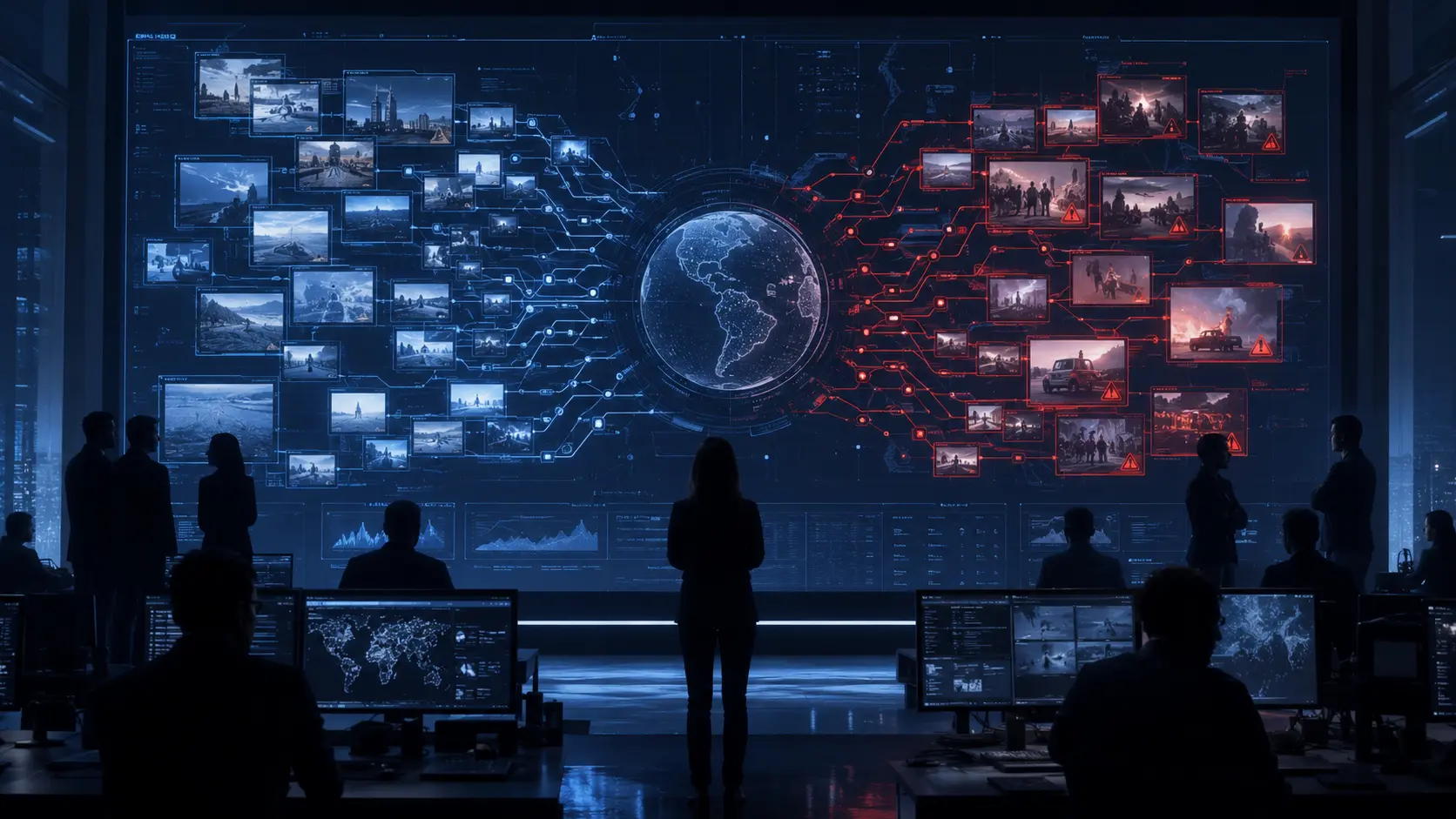
Modern deepfake detection combines computer vision, audio forensics, metadata inspection, behavioral analysis, and contextual intelligence. The objective is to produce a confidence-based assessment, not a casual visual opinion.
A reliable deepfake detection platform does not depend on a single signal. It evaluates multiple layers of evidence and provides analysts with a structured view of possible manipulation indicators.
Facial Forensic Analysis
Facial forensic analysis looks for inconsistencies in facial movement, skin texture, eye behavior, head pose, lighting, and frame transitions. Detection models may analyze whether facial regions behave naturally across time or show artifacts commonly produced by generative models.
This is especially relevant for political deepfake detection because manipulated videos are often compressed, cropped, subtitled, and reposted. A detection system must therefore work across imperfect media conditions.
Metadata Inspection
Metadata can reveal when a file was created, edited, exported, compressed, or passed through specific software. While metadata can be removed or altered, it remains useful when combined with other signals.
Analysts may compare metadata with claimed event timing, official publishing channels, known source footage, and distribution history. Metadata alone is not proof, but it can support a broader forensic conclusion.
Behavioral Biometrics
Behavioral biometrics examine patterns such as speaking rhythm, gesture habits, head movement, facial expression timing, and posture. Public figures often have recognizable communication patterns.
Sudden deviations do not automatically prove manipulation, but they can support deeper analysis when combined with facial, audio, and metadata signals.
Synthetic Speech Analysis
Audio forensics can detect signs of voice cloning, including spectral irregularities, unnatural pauses, missing breath patterns, inconsistent background noise, and mismatched reverberation.
In multilingual India, this is particularly important because AI-generated voice content can be produced in different languages, accents, and regional speech patterns.
Real-Time AI Verification
Real-time AI verification is becoming essential for newsrooms, public agencies, and enterprise security teams. Instead of waiting until manipulated content has already reached millions of users, verification workflows can evaluate suspicious media during intake, publication review, crisis monitoring, or incident response.
This is particularly relevant for emergency broadcast authentication, where a fake announcement, altered advisory, or synthetic official message could create public confusion during a sensitive event.
Why Media Verification Matters for Public Trust
Public trust depends on the ability to distinguish authentic communication from manipulated media. When synthetic content becomes common, people may begin to distrust all digital evidence. This creates two risks at the same time.
First, false content may be believed. Second, real content may be dismissed as fake.
For governments, media houses, and enterprises, this is a serious operational challenge. An organization may need to verify whether a viral video is authentic before issuing a statement. A newsroom may need to authenticate a clip before broadcasting it. A cybersecurity team may need to determine whether an executive video or voice note is genuine. A public safety agency may need to confirm whether an emergency communication has been altered.
Media authenticity verification therefore supports:
- Crisis communication integrity.
- Election information resilience.
- Brand and executive protection.
- Public safety communication.
- Newsroom verification workflows.
- Legal and forensic evidence handling.
- Trust in official digital channels.
A useful verification process should be auditable. It should record what media was analyzed, which forensic signals were reviewed, what confidence score was produced, and what limitations remain. This is important because deepfake detection is not only a technical task; it is also a decision-support function.
The goal is not to create suspicion around every political video. The goal is to build confidence through evidence-based verification.
The Future of Political Deepfake Detection in India
The future of political deepfake detection in India will require a combination of technology, regulation, media literacy, platform accountability, and institutional readiness. Detection models alone cannot solve the problem if organizations lack workflows for escalation, evidence preservation, and public communication.
India’s scale makes this especially complex. A single synthetic narrative can move across languages, regions, platforms, and social groups. The same video may appear as a reel, a cropped WhatsApp forward, a dubbed audio clip, a meme, and a pseudo-news post. Detection systems must therefore support multimodal analysis across video, audio, image, and text.
Deepfake detection in India must work across real-world media conditions. Political videos are often compressed, screen-recorded, subtitled, translated, cropped, and reposted. Detection systems must be resilient enough to analyze imperfect media, not only high-quality original files.
A mature national approach should include:
- Clear labelling standards for synthetic campaign content.
- Rapid takedown and escalation channels.
- Cross-platform provenance tracking.
- AI forensic tools for media and government teams.
- Training for journalists and public communication officers.
- Public awareness campaigns on verification.
- Secure evidence preservation for legal review.
- Continuous monitoring of AI-generated misinformation.
For enterprises and public institutions, the priority is to move from reactive debunking to proactive verification. A robust AI-generated misinformation response capability should connect detection, investigation, reporting, and governance.
Future verification systems will likely combine:
- Multimodal detection across video, audio, image, and text.
- Provenance tracking.
- Watermark analysis.
- Synthetic speech detection.
- Narrative monitoring.
- Risk scoring.
- Analyst-led investigation.
- Evidence-based reporting.
This shift is important because political deepfake detection is not only about identifying manipulated files. It is also about understanding how synthetic media affects public trust, decision-making, and institutional confidence.
Conclusion
Cognitive warfare through repetitive political deepfake campaigns is not defined by a single viral video. It is defined by the systematic weakening of trust: trust in what citizens see, what they hear, what institutions publish, and what media organizations verify.
In India, the combination of high-volume political communication, multilingual audiences, rapid social sharing, and improving generative AI tools creates a significant challenge for digital trust. Viral political speeches involving prominent leaders, including Prime Minister Narendra Modi, have triggered discussions around authenticity and highlighted the importance of media verification.
The responsible response is not speculation. It is structured verification.
For cybersecurity professionals, government agencies, media organizations, and enterprise security teams, synthetic media must be treated as a strategic risk. Deepfake detection technology, forensic workflows, provenance checks, and public communication protocols are now essential components of information integrity.
In the age of AI misinformation, preserving public trust requires more than identifying fake content. It requires building systems that can verify authentic content, document uncertainty, respond quickly, and protect the credibility of digital communication.
Frequently Asked Questions
Ready to experience & accerlate your Investigations?
Experience the speed, simplicity, and power of our AI-powered Investiagtion platform.
Tell us a bit about your environment & requirements, and we’ll set up a demo to showcase our technology.