
How Can Investigators Authenticate Manipulated Images in Deepfake Sextortion Cases?
Deepfake and generative-image technologies can be misused to place an individual’s face or identity into fabricated, compromising, or misleading content. Such images may then be circulated with threats, payment demands, reputational pressure, or attempts to force the victim into taking a particular action.
For investigators, the central question is not simply whether an image appears unusual. The task is to establish how the file was received, preserve its original condition, identify the likely form of manipulation, compare it with authenticated material, and document what the available evidence can and cannot support.
A careful deepfake sextortion investigation should also distinguish between image authentication and suspect attribution. Establishing that an image was manipulated does not automatically reveal who created it, who first distributed it, or who is legally responsible for the offence.
How can investigators authenticate images used in deepfake sextortion?
Investigators can authenticate suspected deepfake sextortion images by preserving the original file and associated communications, documenting the source and transfer history, examining visual and technical indicators, comparing the image with verified reference material, and recording limitations before reaching a conclusion.
The image should be reviewed as part of the wider investigation rather than treated as isolated evidence. Threat messages, account identifiers, payment demands, timestamps, device information, and distribution history may be as important as the visual analysis itself.
What is deepfake sextortion?
Deepfake sextortion involves the use of synthetic or manipulated media to threaten, pressure, embarrass, or extort an individual.
The offender may claim that the content is genuine, threaten to distribute it publicly, send it to family members or employers, or use it as part of a broader impersonation and harassment campaign.
The media used in such cases may take several forms:
- A fully AI-generated image
- A face placed onto another person’s body
- A genuine image altered through generative editing
- Several photographs combined into one composition
- A real image presented with a false identity or explanation
- A screenshot of content created or altered elsewhere
- An image modified using conventional editing software
These categories matter because different manipulation methods may leave different technical and visual indicators.
Investigators should avoid assuming that all deceptive images are technically deepfakes. Conventional editing, selective cropping, false captions, and identity misrepresentation can also create harmful or misleading content.
Why are manipulated images difficult to investigate?
Images used in sextortion and blackmail cases are frequently received in poor investigative condition.
The victim may only have:
- A screenshot
- A thumbnail
- A forwarded message
- A compressed social-media copy
- A cropped version
- An image embedded inside a document
- A photograph of another screen
- A disappearing-message capture
By the time the evidence reaches an investigator, the original filename, metadata, resolution, colour information, or file structure may already have changed.
Emotional pressure can further complicate evidence handling. A victim may delete messages, block accounts, edit screenshots, or repeatedly forward the content while seeking help. These actions are understandable, but they may affect the amount of technical information available for later examination.
Manipulated images may also combine authentic and synthetic elements. A genuine face, background, item of clothing, or room may be placed within an otherwise artificial scene. This can make the image appear credible while still presenting a false event.
What evidence should investigators preserve first?
The first priority is to preserve the image and the surrounding communications in the condition in which they were received.
Where possible, investigators should retain:
- The original image file
- The original filename
- The complete message thread
- Sender usernames and account identifiers
- Profile URLs
- Email addresses or phone numbers
- Dates and times
- Threatening statements
- Payment demands
- Wallet addresses or transaction instructions
- Platform notifications
- Associated audio or video
- Device and application details
- Information about how the file was downloaded or forwarded
Investigators should document whether the image is believed to be an original file, a forwarded copy, a screenshot, or a photograph of another device.
A cryptographic hash can be generated to identify the exact file being examined. This supports evidence tracking by helping teams demonstrate that the analysed file has not been replaced or unintentionally changed during handling.
The complete communication context should also be retained. A technically manipulated image may have limited investigative value if the threat, payment demand, sender account, and distribution history are not preserved alongside it.

How should the source and transmission history be documented?
Investigators should establish how the media moved from its apparent origin to the victim or reporting party.
Useful questions include:
- Which account first sent the image?
- Was the content received directly or forwarded?
- Was it downloaded from a social platform?
- Did the victim receive more than one version?
- Was the content posted publicly before the threat began?
- Did the sender claim to possess additional images?
- Were other people contacted?
- Did the file pass through messaging applications that compress media?
- Was the image originally part of a video?
- Are there related links, usernames, or payment accounts?
The image’s transmission history can help explain technical changes. For example, messaging platforms may resize or re-encode media automatically. A screenshot may remove metadata and change image dimensions. These changes should not be confused with evidence of malicious manipulation.
How can investigators identify the type of image manipulation?
Before examining individual anomalies, investigators should consider which manipulation category best fits the available evidence.
Fully AI-generated imagery
A generative system may have produced the entire image or most of its visible content.
Such images may contain inconsistencies in anatomy, geometry, objects, text, reflections, fine textures, or repeated patterns. However, improvements in generative models mean that obvious defects may not always be present.
Face replacement
A face may have been inserted onto another person’s body or blended into an existing photograph.
Investigators may observe differences around the hairline, jaw, ears, neck, lighting, skin texture, or facial sharpness. The face and body may also appear to come from different imaging conditions.
Image compositing
Elements from multiple photographs may have been combined into one scene.
The resulting image may include inconsistent perspective, shadows, colour balance, resolution, depth, or noise patterns. Individual parts may be genuine even though the complete composition represents an event that never occurred.
Generative editing
AI-assisted editing tools can alter clothing, backgrounds, body regions, facial expressions, or objects without regenerating the entire image.
This can be difficult to identify because the majority of the original photograph may remain unchanged.
Conventional manipulation
Traditional editing tools can still be used to crop, clone, blur, distort, retouch, or insert visual elements.
A cybercrime investigation should not become limited to identifying AI generation. The broader question is whether the image has been altered in a way that changes its meaning or falsely associates a person with a scene.
What visual indicators should investigators examine?
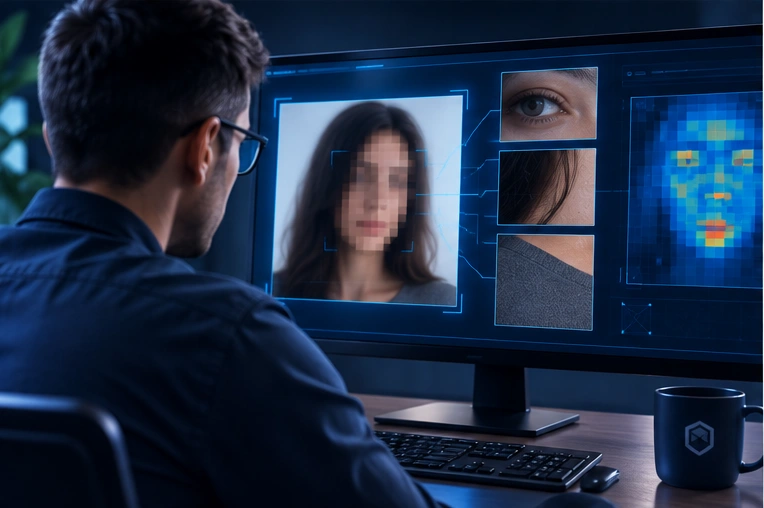
A structured image review may consider the entire scene as well as smaller regions.
Investigators may examine:
- Facial boundaries
- Hair and skin transitions
- Ears and jewellery
- Neck and shoulder alignment
- Clothing edges
- Body proportions
- Hand and finger structure
- Lighting direction
- Shadow placement
- Reflections
- Skin texture
- Background geometry
- Repeated patterns
- Object boundaries
- Differences in sharpness
- Inconsistent colour or noise
- Unnatural blending
- Distorted text or symbols
An anomaly should not be treated as conclusive on its own.
Low-quality cameras, beauty filters, portrait effects, compression, sharpening, lighting conditions, and social-media processing can create unusual visual patterns in authentic images.
A stronger assessment considers multiple indicators, their location, the image quality, and whether a normal technical explanation is available.
For broader information on image deepfake detection, see:
How can metadata and file structure support the investigation?
Metadata and file characteristics may provide useful context about the image, including:
- File format
- Creation or modification information
- Camera or device details
- Image dimensions
- Colour profile
- Editing-software references
- Export history
- Thumbnail information
- Compression characteristics
However, metadata must be interpreted cautiously.
Metadata may be removed through:
- Screenshots
- Messaging applications
- Social-media uploads
- Image editing
- Format conversion
- Cloud processing
- Privacy settings
The absence of metadata does not prove that an image is manipulated. Similarly, the presence of camera information does not prove that the visible content is genuine.
File structure should support the broader investigation, not replace visual and contextual analysis.
Can screenshots of suspected deepfake images still be analysed?
Screenshots can still be examined, but they usually provide less technical information than an original file.
A screenshot may preserve visible indicators such as:
- Facial inconsistencies
- Lighting differences
- Distorted edges
- Background anomalies
- Unnatural blending
- Geometric errors
However, the screenshot may remove:
- Original metadata
- Camera information
- File history
- Some compression characteristics
- Original resolution
- Embedded thumbnails
- Evidence of the original export process
Investigators should therefore request the source file whenever it is available.
If only a screenshot exists, the report should clearly state that the analysis was performed on a secondary representation rather than the original media.
How should suspected images be compared with verified material?
Reference comparison can help investigators test whether a suspected image is consistent with authenticated photographs, locations, or objects.
Verified material may include:
- Known genuine photographs of the individual
- Images captured by trusted devices
- Official identity photographs
- Public images from confirmed accounts
- CCTV footage from the same time period
- Photographs of the claimed location
- Known clothing, jewellery, tattoos, or physical characteristics
- Other evidence from the same communication thread
Investigators should compare features carefully and avoid drawing conclusions from superficial similarity.
A face may resemble a person without establishing that the person is genuinely depicted. Changes in age, lighting, camera angle, expression, image quality, and appearance can also affect comparisons.
Reference material should be authenticated before it is used. Comparing one uncertain image with another uncertain image may reinforce an incorrect conclusion.
Why must image authentication be separated from attribution?
Image authentication asks whether the content appears genuine, manipulated, synthetic, or inconclusive.
Attribution asks who created, distributed, controlled, or commissioned the media.
These are different investigative questions.
A technical finding that an image was manipulated does not independently establish:
- Who created it
- Which tool was used
- Who uploaded it first
- Who controlled the sender account
- Whether the sender and creator are the same person
- Why the image was created
- Whether an accused individual participated
- Criminal or civil responsibility
Attribution may require additional evidence such as account records, device examinations, communication logs, payment trails, IP information, platform records, witness statements, or recovered project files.
A forensic report should clearly distinguish media findings from conclusions about identity, intent, or responsibility.
What role can deepfake detection play in sextortion investigations?
Deepfake detection can support sextortion investigations by helping teams identify whether submitted images contain signs of synthetic generation, facial replacement, compositing, or other forms of manipulation.
A dedicated deepfake detection for sextortion investigations capability could help agencies:
- Review victim-submitted image evidence
- Identify suspicious facial or scene-level regions
- Compare multiple versions of the same image
- Assess whether separate media files appear connected
- Prioritise evidence for specialist examination
- Document technical observations
- Record confidence and limitations
- Support coordination between cybercrime and forensic teams
The purpose of this capability would not be to make an automatic decision about authenticity or responsibility. It should provide investigators with explainable findings that can be evaluated alongside messages, account activity, payment demands, and other case evidence.
This section can later be linked naturally to a dedicated Deepfake Detection for Sextortion Investigations page if PaladinAi creates one.
How should investigators handle inconclusive results?
Not every image can be classified confidently.
An inconclusive result may arise when:
- The original file is unavailable
- The image is heavily compressed
- Only a screenshot was provided
- The face is partially obstructed
- The resolution is too low
- The image has been repeatedly forwarded
- Important regions have been cropped
- Reference material is limited
- Technical indicators conflict
- Multiple editing processes were applied
Investigators should not force a binary conclusion when the available evidence does not justify one.
An inconclusive assessment means that the image cannot be reliably classified using the material currently available. It does not prove that the image is genuine, and it does not prove that it is manipulated.
The report should identify what additional evidence could improve the assessment, such as the original file, another version of the image, related video footage, device data, or authenticated reference images.
How can multimodal evidence strengthen the investigation?
A sextortion case may involve more than one image.
Investigators may also receive:
- Threatening voice notes
- Video clips
- Screen recordings
- Social-media posts
- Fake profiles
- Edited documents
- Payment requests
- Repeated images with different captions
Reviewing these materials together may reveal inconsistencies or connections that are not visible when each file is examined separately.
For example:
- A voice message may claim the image was recorded at a certain time.
- The image background may not match the stated location.
- A video may show that the still image was extracted from unrelated footage.
- Different fake accounts may reuse the same synthetic face.
- The same edited image may appear in several cases.
A multimodal deepfake detection technology approach can support analysis across images, audio, and video while allowing investigators to compare findings within the wider case context.
What should a deepfake sextortion investigation report contain?
A structured report should explain what evidence was examined, what indicators were identified, and which conclusions remain unsupported.
| Report component | Purpose |
|---|---|
| File identification | Records the exact image examined |
| Source history | Documents how and from whom it was received |
| Preservation details | Records hashes, storage, and handling |
| Image-quality assessment | Explains resolution and processing limitations |
| Suspected manipulation category | Describes the likely form of alteration |
| Technical observations | Records relevant visual and file-based indicators |
| Reference comparison | Identifies authenticated material used for comparison |
| Contextual evidence | Connects the image with messages, accounts, and events |
| Confidence assessment | Communicates the strength of the technical finding |
| Limitations | States what could not be established |
| Attribution boundary | Separates media analysis from suspect identification |
| Recommended action | Lists additional evidence or escalation needs |
The conclusion should be understandable to investigators who are not specialists in image forensics.
Technical terminology should be explained, and relevant regions of the image should be identified where appropriate.

When should a case be escalated for specialist review?
Specialist review may be required when:
- The image is linked to an immediate threat
- The victim is facing active payment demands
- Multiple people have received the content
- The image is being distributed publicly
- The original file is unavailable
- The media may be required as formal evidence
- Technical findings remain contradictory
- Several victims appear connected to the same offender
- Images, audio, and video are being used together
- Identification or attribution is being considered
Depending on the case, escalation may involve cybercrime investigators, digital-forensics units, image analysts, platform liaison teams, or victim-support personnel.
PaladinAi’s cybercrime investigation support use case explains how suspicious digital evidence can be examined within wider investigative workflows:
How can agencies prepare for deepfake sextortion cases?
Agencies can prepare by establishing consistent procedures before a case is received.
Preparation may include:
- Victim-sensitive evidence-intake procedures
- Secure methods for receiving intimate or sensitive media
- Original-file preservation guidance
- Standard documentation templates
- Access controls for sensitive evidence
- Image-analysis and comparison workflows
- Escalation criteria
- Cross-platform preservation procedures
- Training on generative-image manipulation
- Coordination between cybercrime and forensic teams
- Clear rules for reporting uncertain findings
Sensitive evidence should be accessible only to authorised personnel and handled in a manner that reduces unnecessary exposure.
Training should also reinforce that a manipulated image can cause real harm even when the depicted event never occurred. Investigators should address the technical evidence without dismissing the victim’s experience or the seriousness of the threat.
For broader information on deepfake detection for law enforcement, see:
Conclusion
Deepfake sextortion cases require more than a visual judgement about whether an image looks genuine.
Investigators should preserve the original media and surrounding communications, document the transfer history, identify the likely manipulation method, examine technical and contextual indicators, compare the content with authenticated material, and report limitations clearly.
Image authentication can help establish whether content has been altered or synthetically generated. It cannot independently determine who created the image, who distributed it, or who should be held responsible.
By combining careful evidence handling, technical analysis, human review, and wider cybercrime investigation methods, agencies can respond to manipulated-image threats without treating automated findings as unquestionable proof.
Frequently Asked Questions
Ready to experience & accerlate your Investigations?
Experience the speed, simplicity, and power of our AI-powered Investiagtion platform.
Tell us a bit about your environment & requirements, and we’ll set up a demo to showcase our technology.