

How Can Law Enforcement Agencies Use a Private AI Assistant Without Exposing Sensitive Data?
Law enforcement agencies routinely work with information that cannot be handled like ordinary workplace content. Case files, witness accounts, intelligence notes, incident reports, internal directives, digital evidence indexes, and operational records may contain personal identities, confidential leads, protected sources, or details connected to ongoing investigations.
Artificial intelligence can help personnel review and organize this information more efficiently. However, using a general public AI service for restricted material may raise questions about where data is processed, how long it is retained, who can access system logs, and whether the service meets the agency's security and records-management requirements.
A private AI assistant provides a more controlled approach. It can operate within approved infrastructure, connect only to permitted data sources, and limit access according to the user's role, unit, case assignment, or clearance level.
This does not mean that private deployment removes every security risk. Agencies still need strong identity controls, encryption, activity monitoring, carefully defined retention rules, regular testing, and human verification of important outputs.
Quick Answer
Law enforcement agencies can use a private AI assistant securely by deploying it within an approved on-premise, private-cloud, or air-gapped environment and restricting it to authorized users and selected internal data sources. The system should include role-based access, encryption, audit logs, source-linked answers, defined retention policies, and mandatory human review.
What Is a Private AI Assistant for Law Enforcement?
A private AI assistant is an internally governed AI system that helps authorized personnel interact with approved information through natural-language questions.
Instead of manually searching across large folders, databases, and document repositories, a user may ask the assistant to locate relevant records, summarize selected documents, identify recurring entities, organize events by date, or retrieve internal procedural guidance.
The term 'private' refers to more than the appearance of a closed chatbot. It means the organization can control important operational elements such as: where the AI system is hosted; which repositories it can access; which personnel are allowed to use it; what information each user is permitted to retrieve; how prompts, responses, and files are retained; which actions are logged; what types of tasks are prohibited; and when a human reviewer must approve or verify an output.
The objective is not to replace investigators or analysts. It is to provide a secure information-support layer that helps them navigate complex records more efficiently.
Law enforcement organizations evaluating controlled AI workflows can explore the PaladinAi AI Assistant for secure interaction with approved internal information.
Why May Public AI Tools Be Unsuitable for Sensitive Police Data?
Public AI platforms can be useful for general research, drafting, or administrative work. They are not automatically suitable for confidential law enforcement information.
Limited visibility into data processing
An agency may not have full control over where information is processed, whether it is temporarily cached, how system logs are managed, or which third parties support the service.
Accidental disclosure by users
Personnel may unintentionally enter names, addresses, evidence details, account information, operational plans, or intelligence notes into an unapproved platform.
Retention and records-management concerns
Different providers may apply different rules to prompts, uploaded files, conversation histories, system telemetry, and backup copies. These conditions may not match internal evidence, privacy, or retention policies.
Inadequate access separation
A general-purpose chatbot may not provide the case-level, unit-level, or document-level permission controls required within a law enforcement environment.
Unverified or fabricated responses
AI tools can produce incomplete, misleading, or unsupported answers. In an investigation, even a well-written but incorrect summary can create confusion if it is treated as an established fact.
For these reasons, law enforcement agencies need a formal AI-governance process rather than relying on ad hoc use of public tools.
How Can a Private AI Assistant Support Law Enforcement Work?

A private AI assistant can assist with information-heavy tasks when its use is restricted to approved data and every material output remains subject to human review.
1. Searching Large Case Collections
An investigation may involve hundreds or thousands of pages spread across incident reports, interview notes, financial records, forensic summaries, correspondence, and intelligence documents.
A private AI assistant can help authorized personnel ask focused questions such as: Which reports mention a particular vehicle registration? Where does a selected phone number appear? Which documents refer to the same address? What events were recorded during a defined period? Which records mention a specific organization? Where was a named device or account first referenced?
A well-designed system should return the relevant source passages, not only a generated conclusion.
2. Summarizing Lengthy Documents
Investigators may need to review large volumes of material under time pressure. An AI assistant can prepare an initial summary of approved documents such as: incident reports; witness statements; cybercrime complaints; interview transcripts; intelligence notes; financial transaction records; internal investigation files; and technical assessment reports.
These summaries should be treated as navigational support. They do not replace examination of the original material.
3. Creating Preliminary Timelines
A private AI assistant can identify dates, times, locations, people, and reported events across multiple records.
It may help create a first-pass chronology showing: when an event was reported; which individuals were present; when communications occurred; when evidence was collected; when financial transactions were recorded; and where accounts differ on timing.
A trained investigator must still validate the sequence, resolve contradictions, and distinguish confirmed facts from allegations.
4. Comparing Statements and Reports
The system can help locate differences and similarities across witness accounts, interview records, or officer reports.
For example, it may highlight: inconsistent dates; different descriptions of the same event; missing names or locations; repeated phrases; changes between earlier and later statements; and information appearing in one record but not another.
The assistant should not declare whether a person is truthful. Its role is to identify material that may require closer human examination.
5. Extracting Entities From Approved Records
AI can assist in identifying references to: individuals; companies and organizations; addresses; telephone numbers; email addresses; bank accounts; vehicles; devices; usernames; dates; locations; and digital identifiers.
These extracted entities may then be reviewed in an approved investigation-intelligence or link-analysis environment.
The IntelliView investigation intelligence platform can help analysts examine relationships among people, places, events, accounts, devices, and evidence.
6. Preparing Investigation Briefs
A private AI assistant can help organize verified information into a structured working brief.
A brief may include: case background; important entities; known events; relevant documents; source references; unresolved questions; conflicting information; and analyst observations.
Important facts should always remain traceable to their original records.
7. Retrieving Policies and Procedures
Not every use case needs access to active investigation data.
A private AI assistant may also help personnel search internal material such as: standard operating procedures; evidence-handling guidance; technical manuals; training documents; departmental policies; legal reference notes; and approved operational instructions.
This can reduce the time required to locate relevant guidance while ensuring that responses are based on current, approved documents.
8. Supporting Cross-Document Review
A single investigation may contain information stored in different formats and repositories. A private AI assistant can help users identify relationships across selected materials without requiring them to open each document separately.
For example, it may help answer: Which records mention both a person and a location? Which accounts refer to the same transaction? Where does a device identifier appear across multiple cases? Which reports contain references to a previously known organization?
Access should remain limited to information the user is already authorized to view.
Does a Private AI Assistant Guarantee That Data Will Never Be Exposed?
No responsible system can promise that sensitive data will never be exposed.
Private deployment can reduce exposure risk by keeping processing, access, and storage within controlled infrastructure. Security still depends on how the system is built, configured, monitored, and used.
A private AI environment can remain vulnerable if it includes: overly broad user permissions; weak account security; compromised credentials; insecure integrations; outdated software; poor encryption practices; incorrectly configured storage; unauthorized data ingestion; malicious insider activity; unmonitored exports; prompt-injection attacks; or inadequate physical security.
Privacy is therefore an operational model, not a marketing label.
On-Premise, Private-Cloud, and Air-Gapped AI Deployment
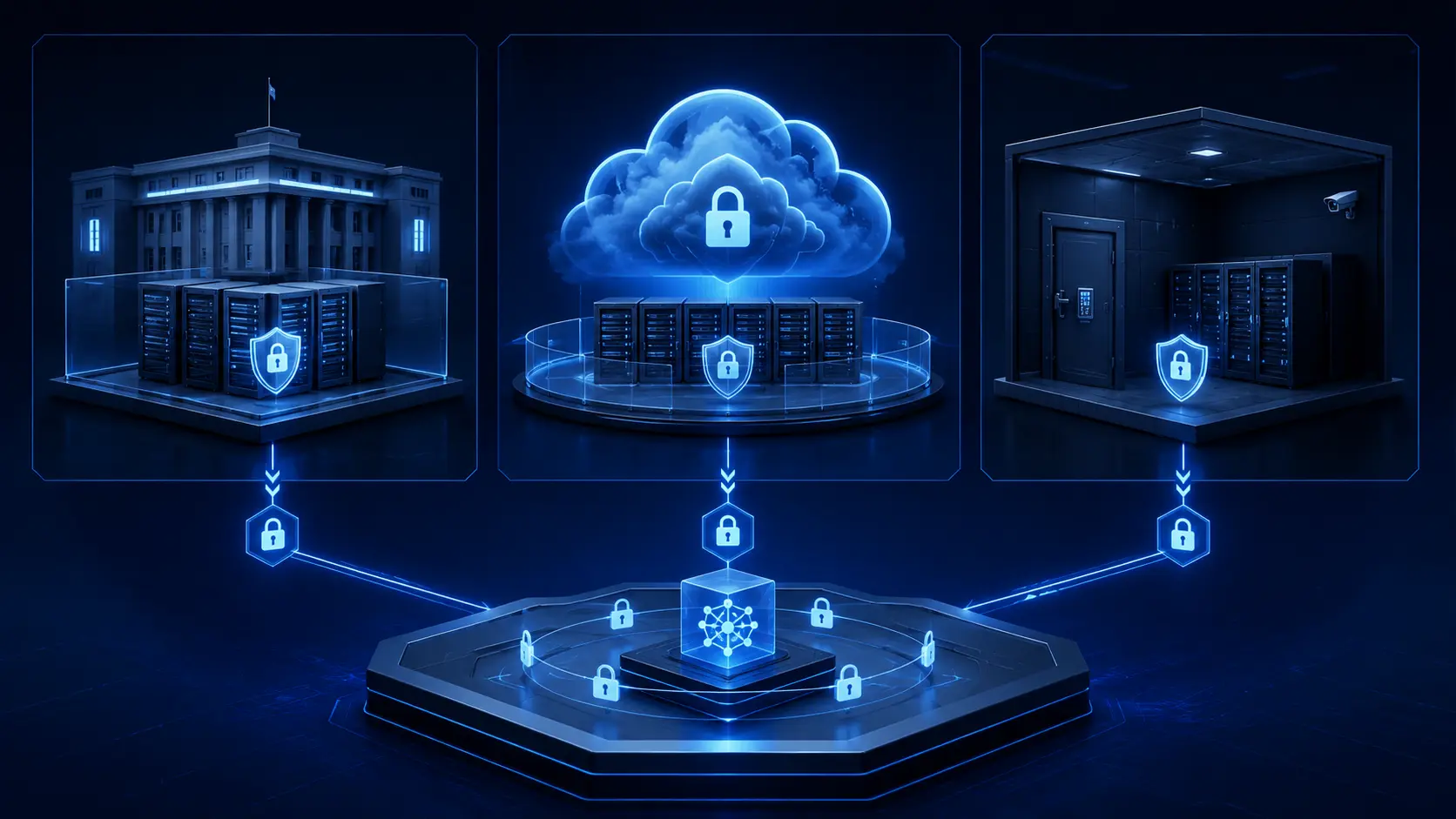
Different agencies may require different deployment models depending on data sensitivity, infrastructure, legal requirements, and operational constraints.
On-Premise AI Deployment
An on-premise AI assistant operates within infrastructure managed by the agency or an authorized government organization.
This model can provide direct control over: data location; network access; hardware; user authentication; system configuration; logging; integration; retention; and security monitoring.
On-premise deployment may be appropriate where data must remain within a specific facility, department, or government-controlled network.
However, it also requires internal capacity for system maintenance, security updates, hardware management, monitoring, and technical support.
Private-Cloud AI Deployment
A private-cloud model can provide scalable computing in an isolated and approved cloud environment.
Before adoption, agencies should assess: the physical location of the data; data-residency requirements; whether the provider can access customer information; who controls encryption keys; where backups are stored; which subprocessors are involved; how incidents are reported; how deletion is verified; and how logs are preserved.
A private cloud can be secure, but the term alone does not prove that a particular environment is appropriate for restricted law enforcement data.
Air-Gapped AI Deployment
An air-gapped AI assistant operates within an environment separated from public networks.
This model may be considered for highly sensitive or classified workflows. It can reduce certain external network risks, but it introduces additional operational requirements.
Agencies must establish controlled methods for: importing approved data; applying security patches; updating models; transferring authorized outputs; installing software; maintaining hardware; and monitoring offline activity.
Air-gapping does not eliminate risks involving physical access, insiders, removable media, or configuration mistakes.
Public AI Chatbot vs Private AI Assistant
| Area | Public AI chatbot | Private AI assistant |
|---|---|---|
| Primary use | General-purpose assistance | Controlled organizational workflows |
| Hosting | Externally managed public service | On-premise, private cloud, or air-gapped |
| Data access | Public information or user submissions | Approved internal repositories |
| Permissions | General account controls | Role-, unit-, case-, or document-level controls |
| Retention | Provider-defined | Organization-defined |
| Auditability | Depends on provider | Can be configured for agency requirements |
| Integrations | Broad external integrations | Approved internal systems |
| Source grounding | May vary | Can be required for every response |
| Governance | User and provider dependent | Agency-defined policies |
| Suitability for restricted data | Not by default | Potentially, after security assessment |
What Security Controls Should a Law Enforcement AI Assistant Include?
A secure deployment requires multiple layers of technical, procedural, and organizational control.
Role-Based Access
Users should only see information that corresponds to their responsibilities, assigned cases, unit, and clearance.
Permissions may need to operate at several levels: individual user; team; department; case; repository; document; classification; and function.
A user who can summarize an assigned case should not automatically gain access to unrelated investigations.
Strong Authentication
The platform should support secure identity management, multi-factor authentication where appropriate, account lifecycle controls, session restrictions, and rapid revocation of access.
Shared credentials should not be used.
Encryption
Sensitive information should be protected both while stored and while moving between approved systems.
Agencies should also define: who owns encryption keys; how keys are stored; how often they are rotated; who can access them; and what happens if a key is compromised.
Detailed Audit Trails
The system should record activity such as: user sign-ins; submitted prompts; accessed data sources; retrieved documents; generated answers; exported content; administrative changes; and failed access attempts.
Audit records should be protected from unauthorized editing or deletion.
Restricted Data Connections
The assistant should only connect to approved data sources.
Giving one system unrestricted access to every available repository may increase the consequences of a compromised account or misconfiguration.
Agencies should connect only the information necessary for clearly defined tasks.
Source-Linked Answers
Where possible, responses should show the document, record, or passage used to support the answer.
Source-linked responses allow users to verify: whether the correct document was used; whether the passage was interpreted accurately; whether the information is current; and whether the answer omitted important context.
An unsupported answer should not be treated as a case fact.
Retention and Deletion Policies
The agency should determine how long the following are stored: prompts; responses; uploaded files; conversation histories; system logs; generated summaries; and exported outputs.
Different categories of data may require different retention periods.
Security and Reliability Testing
Testing should cover more than whether the assistant produces useful answers.
Agencies should assess: attempts to retrieve unauthorized records; prompt-injection attacks; permission bypass; data leakage; hallucinated facts; unsupported citations; language performance; inaccurate entity extraction; inconsistent summaries; adversarial inputs; and performance with incomplete records.
Testing should continue after deployment rather than being treated as a one-time exercise.
Human Oversight
A qualified person should verify every important AI-generated summary, extracted entity, comparison, timeline, or analytical brief before it influences an investigation.
The system can accelerate review. It cannot assume legal or investigative responsibility.
Why Must Human Judgment Remain Central?
A private AI assistant works only with the information it can access. It may produce a poor answer when records are incomplete, contradictory, outdated, badly scanned, or incorrectly labeled.
Its output may also be affected by: ambiguous language; spelling variations; translation errors; missing context; inconsistent names; restricted permissions; model limitations; low-quality source material; and unsupported inference.
An AI system does not understand motive, credibility, proportionality, or legal context in the same way as an experienced investigator.
Human personnel remain responsible for examining the evidence, evaluating alternative explanations, following procedure, and making accountable decisions.
What Should Law Enforcement Agencies Avoid Using AI For?
A private AI assistant should have clearly defined operational boundaries.
Without specific legal authority, testing, governance, and oversight, agencies should not rely on it to: determine whether someone is guilty; recommend an arrest automatically; decide whether a witness is truthful; assign a threat level without human review; generate unsupported suspect profiles; replace formal evidence examination; alter original evidence files; make final legal conclusions; independently initiate enforcement action; or present generated text as verified intelligence.
The assistant should support authorized personnel, not replace accountable decision-makers.
A Practical Framework for Secure Adoption

Step 1: Choose a Defined Use Case
Begin with one limited problem, such as searching internal policy documents or summarizing selected reports.
Do not start by connecting the assistant to every agency repository.
Step 2: Classify the Information
Determine what data the assistant will process and how that data is classified.
This may include: personal information; criminal intelligence; witness details; investigation notes; digital evidence records; financial information; operational plans; classified material; or data received from another agency.
Step 3: Select the Appropriate Deployment Model
Choose between on-premise, private-cloud, and air-gapped deployment based on the information involved, operational needs, and applicable policy.
Step 4: Establish Access Rules
Define: who can use the system; which repositories each user can access; whether access is linked to case assignment; which actions are permitted; and which outputs may be exported.
Step 5: Set Response Boundaries
The assistant should be configured to retrieve, organize, and summarize approved information without making prohibited decisions or presenting unsupported conclusions.
Step 6: Test Before Operational Use
Conduct security, privacy, performance, bias, and reliability testing before deployment.
Testing should include deliberate attempts to access restricted information.
Step 7: Train Personnel
Users should understand: what information they may enter; what data must never be entered; how to review source references; which outputs require verification; how to report errors; which uses are prohibited; and how activity is logged.
Step 8: Run a Controlled Pilot
Start with a limited number of users, a narrow data collection, and a clearly defined task.
Measure accuracy, time savings, user behaviour, security incidents, and operational value before expanding.
Step 9: Monitor Continuously
Review: system logs; failed access attempts; user feedback; output quality; security alerts; permission structures; connected repositories; and policy compliance.
Step 10: Assign Accountability
Responsibility should be clearly allocated for: system ownership; data governance; cybersecurity; legal review; user training; model performance; incident response; and audit oversight.
How PaladinAi's AI Assistant Supports Controlled Information Access
PaladinAi's AI Assistant is designed to help authorized teams work with complex internal information within a controlled AI environment.
Depending on operational requirements, it can be deployed through on-premise, private-cloud, or air-gapped infrastructure. This gives organizations greater control over data location, connected repositories, permissions, and system access.
Potential law enforcement applications include: searching approved internal records; summarizing selected case documents; extracting people, places, dates, and organizations; comparing information across authorized files; organizing investigation timelines; retrieving internal policy guidance; and preparing source-grounded analytical briefs.
The platform is intended to support trained personnel. Its outputs should remain subject to agency policy, human verification, and applicable legal requirements.
Explore the PaladinAi AI Assistant.
How a Private AI Assistant Can Work With Other Investigation Tools
A private AI assistant becomes more valuable when it supports a governed investigation workflow rather than operating as an isolated chatbot.
For example: PaladinAi AI Assistant can help authorized users search and summarize selected internal information. IntelliView can support the analysis of relationships among people, places, events, accounts, devices, and evidence. PhoneticAI can help process approved audio through transcription, translation, speaker diarization, speaker identification, sentiment analysis, and emotion analysis. DeepGaze can help assess suspicious video, audio, and image material for indicators of AI-generated manipulation.
Each platform should retain a defined role, restricted access, and traceable outputs.
Explore investigation intelligence with IntelliView.
Learn about audio intelligence with PhoneticAI.
Explore media verification with DeepGaze.
Conclusion
Law enforcement agencies do not need to choose between operational use of AI and protection of sensitive information.
A properly governed private AI assistant can help authorized teams locate, summarize, compare, and organize internal records while keeping processing within an approved environment.
However, the deployment model is only one part of the security framework. Agencies also need limited access, strong authentication, encryption, audit trails, approved data connections, source-linked answers, testing, user training, and human oversight.
The safest path is to begin with a narrow use case, connect only the information required for that task, verify every important output, and expand only after the system has demonstrated security, reliability, and operational value.
Frequently Asked Questions
Ready to experience & accerlate your Investigations?
Experience the speed, simplicity, and power of our AI-powered Investiagtion platform.
Tell us a bit about your environment & requirements, and we’ll set up a demo to showcase our technology.