

Face Swap Detection in Digital Forensics: Methods, Challenges & AI Analysis
A doctored photo surfaces in a high-stakes criminal trial: one face seamlessly swapped onto another's body, threatening to derail justice.
In digital forensic labs, investigators face mounting pressure to unmask these manipulations amid rising deepfake threats.
This article explores workflows from evidence acquisition to AI deepfake detection models,, visual artifact hunting, metadata scrutiny, and real-world case studies-revealing detection challenges and evasion tactics that demand sharper scrutiny.
Common Face Swap Methods Used in Deepfake Images
Investigators categorize face swaps into four main methods: autoencoder-based, GAN-based, landmark warping, and diffusion models. These techniques power most deepfakes in manipulated images. Forensic labs study them to spot swap artifacts.
Autoencoder-based approaches use neural networks with extended training on source and target faces. It encodes faces into a latent space, then decodes swaps with high fidelity. Detection signatures include pixel anomalies around the jawline and inconsistent skin texture.
GAN-based approaches rely on adversarial training to generate realistic facial features. It pits a generator against a discriminator for better blending. Investigators look for blending seams and lighting discrepancies in the output.
Real-time mobile applications enable landmark warping for quick swaps. It aligns faces using facial landmarks and warps textures. Common traces are edge detection irregularities and unnatural eye gaze inconsistency.
Diffusion-based methods use iterative refinement to in paint swapped faces seamlessly. It denoises masked regions iteratively. Forensic analysis reveals noise patterns and frequency mismatches from this process.
Key Forensic Challenges in Face Swap Detection
Face swaps evade detection in compressed social media images due to lossy artifacts masking manipulation traces. Investigators face significant hurdles when analyzing these manipulated images. Investigators must navigate subtle alterations hidden by everyday processing.
Compression artifacts destroy error level analysis patterns in face swap detection. Error level analysis relies on uniform compression levels, but recompression introduces noise that obscures pixel anomalies and blending seams. This forces forensic investigators to seek alternative methods like frequency analysis.
Low-resolution images under 256 pixels challenge edge detection and facial landmark alignment. Details such as skin texture or eye gaze inconsistencies vanish, complicating AI models for deepfake identification. Experts recommend upscaling techniques, though they risk introducing new artifacts.
Multiple face swaps and adversarial perturbations further complicate image forensics. Layered manipulations create overlapping swap artifacts, evading machine learning detection. Investigators isolate tampering through frequency coefficients and noise patterns.
- Compression destroys error level analysis patterns, masking initial manipulation traces.
- Low-resolution limits landmark detection and texture analysis.
- Multiple swaps produce complex blending seams and color inconsistencies.
- Adversarial attacks target neural networks, reducing detection accuracy.

Digital Forensics Workflow for Face Swap
Forensic workflows follow established standards, ensuring high evidence admissibility through documented processes. Investigators in digital forensic labs use a standard process: identification, preservation, collection, processing, analysis, presentation, and review.
This structured approach emphasizes reproducibility for court, allowing forensic investigators to demonstrate every step. For face swap detection, reproducibility helps verify findings on manipulated images and deepfakes.
Evidence handling steps begin with secure acquisition and chain of custody. Labs preview analysis using internal forensic tools for swap artifacts and pixel anomalies. This workflow supports court evidence by maintaining integrity throughout.
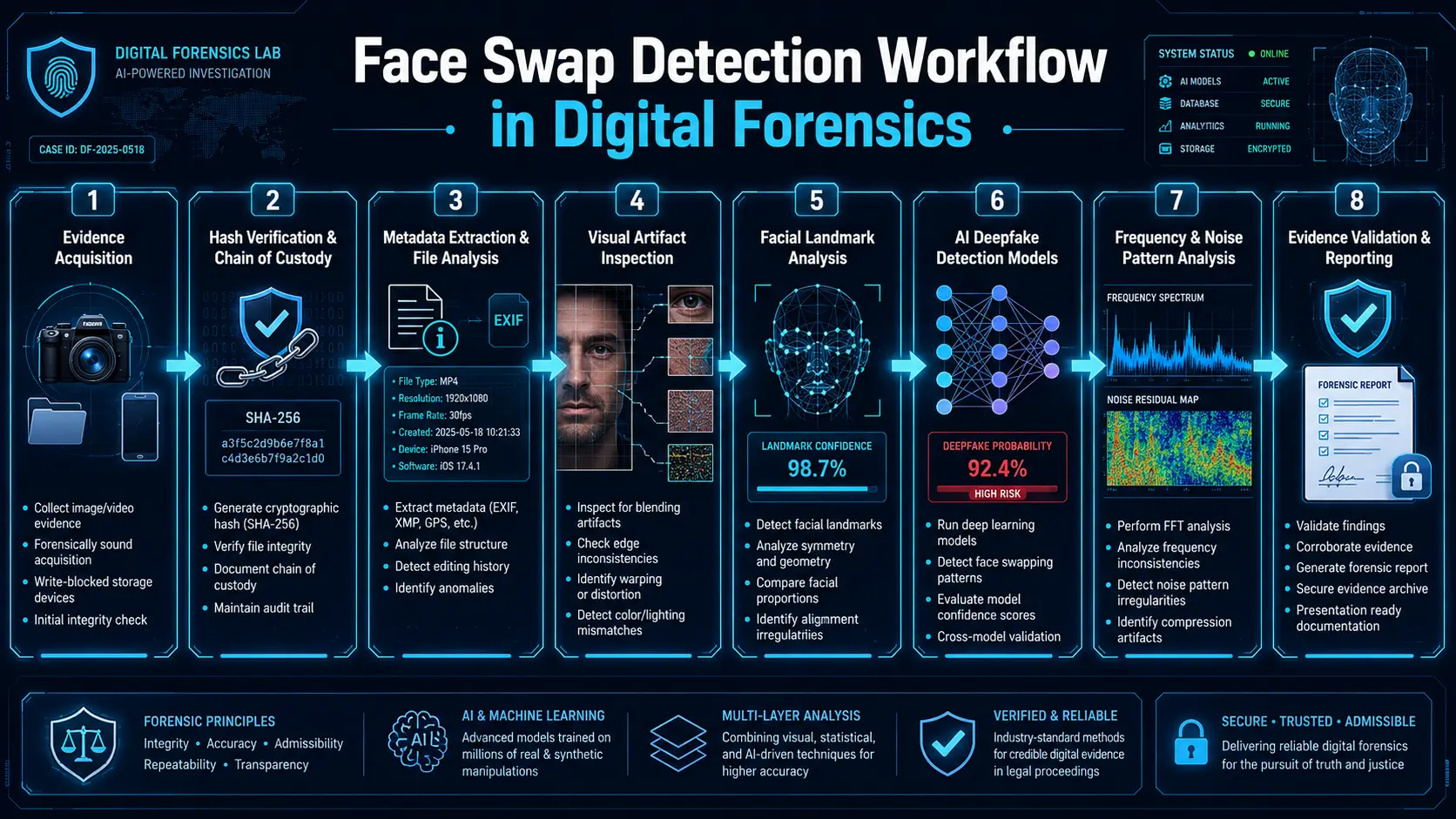
Practical examples include hashing images before analysis to detect blending seams or color inconsistencies. Experts recommend documenting each phase to counter defense challenges in cybercrime investigations.
Evidence Acquisition Process in Digital Forensics
Acquire images using write-blockers and forensic imagers to preserve original byte-for-byte integrity. This step prevents any alteration during evidence acquisition in digital forensic labs.
Forensic investigators follow these numbered steps for reliable collection:
- Use hardware write-block to isolate the source device.
- Create a forensic image using trusted forensic software.
- Perform hash verification using SHA-256 to confirm exact copies.
- Document acquisition with the 5W method: who, what, when, where, why.
- Store securely with encryption for tamper protection.
These steps typically take 15-45 minutes per device, depending on size. In face swap detection, this ensures manipulated images retain metadata for later analysis.
Practical advice includes verifying hashes immediately after imaging. This process aids in spotting compression artifacts or noise patterns from AI-generated faces.
Chain of Custody in Digital Evidence Handling
Chain of custody forms often face rejection in digital cases due to incomplete documentation. Proper handling ensures evidence admissibility in court for investigations into manipulated images and deepfakes.
Forensic labs meet these five key requirements to maintain integrity:
- Assign unique evidence tags to every item.
- Keep detailed transfer logs noting who, when, and why.
- Conduct dual-hash verification with MD5 and SHA-256.
- Use sealed tamper-evident packaging for physical security.
- Employ audit trail systems for tracking.
A sample custody form includes fields for item description, handler signatures, dates, and hash values. This documentation supports image forensics by proving no tampering occurred during face swap detection.
Visual Inspection Techniques for Detecting Face Swaps
Trained investigators often spot face swap artifacts during an initial visual triage using basic image viewers with zoom. They examine manipulated images for inconsistencies in lighting and shadows, building skills through practice and side-by-side comparisons.
Investigators use zoom functions to examine manipulated images. Look for inconsistencies in lighting and shadows that reveal digital manipulation.
Combine visual checks with side-by-side comparisons. This method uncovers swap artifacts in everyday cybercrime investigations.
Artifact Identification in Deepfake Image Analysis
Examine specific artifacts: skin texture mismatch with real pores versus smooth AI generation, hairline pixelation, and eye specular highlights.
Other key signs include teeth alignment issues and mismatched shadow direction. For example, a swapped face might cast light from the wrong angle.
Look for color bleeding at boundaries and ear geometry flaws. Neck blending shows unnatural transitions. Specular highlights on eyes or skin appear inconsistent with real lighting.
Use a checklist during analysis: skin texture, teeth, shadows, color, ears, neck, highlights.
Seam and Blend Analysis in Face Swap Detection
Edge detection reveals seams in face swaps using filters. Apply these techniques to highlight blending seams.
Error level analysis visualizes compression differences with high sensitivity. Brighter areas indicate tampering. Combine it with frequency analysis to spot high-frequency losses.
Blend zone analysis targets transition regions around the face. Check for pixel anomalies and noise patterns.
Metadata and File Analysis for Deepfake Detection
Metadata reveals manipulation through timestamp inconsistencies and app signatures. This passive analysis preserves evidence integrity in digital forensic labs.
Forensic investigators extract metadata fields to reveal editing traces. This complements visual methods for face swap detection.
Compression artifacts and GPS anomalies often indicate digital manipulation.
Advanced Computational Methods for Face Swap Detection
Computational methods achieve high accuracy using ensemble neural network models. These lab-grade analysis tools process large volumes of data in digital forensic labs.
Forensic investigators use these methods to spot face swap artifacts in manipulated images. Ensemble models combine neural architectures for robust detection.
Pixel anomalies and blending seams stand out under frequency analysis.
Comparison of Face Swap Detection Techniques
| Detection Technique | Primary Purpose | Strengths | Limitations |
|---|---|---|---|
| Metadata Analysis | Detect editing traces | Fast initial verification | Metadata can be removed |
| Visual Artifact Inspection | Identify visible inconsistencies | Useful for quick triage | Human-dependent |
| Facial Landmark Analysis | Detect geometry mismatch | Effective on facial alignment | Weak on low-resolution images |
| Frequency Analysis | Detect synthetic generation patterns | Strong against GAN artifacts | Compression reduces effectiveness |
| Noise Pattern Analysis | Identify pixel inconsistencies | Helpful in layered manipulations | Computationally intensive |
| AI Deepfake Detection Models | Automated synthetic media detection | High scalability and accuracy | Vulnerable to adversarial attacks |
| Error Level Analysis | Highlight compression inconsistencies | Useful in basic tampering cases | Ineffective after recompression |

AI Detection Models for Deepfake and Face Swap Analysis
AI detection models form the core of face swap analysis in digital forensic labs. They excel at identifying synthetic faces through neural network patterns.
Forensic investigators select models based on use case, from quick triage to high-stakes court evidence.
Experts recommend transfer learning with pre-trained models for custom datasets. Explainable AI helps reduce false positives in law enforcement.
Facial Landmark Analysis in Image Forensics
Facial landmark detection reveals inconsistencies in most swaps through geometric comparisons.
The process includes:
- Detect landmarks
- Align faces
- Measure distances
- Analyze gaze and structure
Investigators flag mismatches in teeth alignment or hairline irregularities. This method pairs well with edge detection.
Feature Extraction Techniques for Deepfake Detection
Extract multiple forensic features including frequency coefficients, perceptual hashing, and texture patterns.
Key techniques include:
- Frequency spectrum analysis
- Noise pattern identification
- Perceptual hashing
- Lighting inconsistency detection

Real-World Deepfake Investigation Case Example
In a widely reported cybercrime investigation, forensic analysts examined manipulated facial imagery used in an online financial fraud campaign. Attackers deployed AI-generated face swaps to impersonate senior executives during digital communication exchanges and identity verification procedures.
Investigators identified several forensic indicators during the analysis process, including abnormal facial blending around the jawline, inconsistent eye reflections, irregular skin texture transitions, and metadata timestamp anomalies. Additional frequency spectrum analysis revealed synthetic generation patterns commonly associated with GAN-based image manipulation techniques.
The forensic workflow combined metadata extraction, facial landmark analysis, visual artifact inspection, and AI-powered deepfake detection models to validate the manipulation. Investigators also performed hash verification and documented the chain of custody to preserve evidence admissibility throughout the investigation.
The findings demonstrated how layered forensic methodologies improve the reliability of face swap detection in cybercrime investigations involving manipulated digital evidence and synthetic media attacks.
Case Studies and Limitations in Face Swap Detection
Investigators combine visual and machine learning methods for face swap detection. This multi-method strategy uncovers manipulated images more reliably.
Limitations include compression artifacts masking swap artifacts and adversarial edits reducing detection accuracy.
Evasion Techniques and Countermeasures in Deepfake Detection
Adversarial perturbations challenge classifiers in face swap detection. Ensemble methods help restore robust performance.
Common evasion types include compression, layered generation, adversarial noise, and blending attacks.
Countermeasures include:
- Multi-scale analysis
- Frequency residual analysis
- Noise reconstruction
- Robust model training
Conclusion: Future of Face Swap Detection in Digital Forensics
Face swap technology has evolved into a serious threat for digital investigations, challenging the authenticity of visual evidence used in legal and intelligence workflows.
To address these risks, forensic labs must adopt advanced detection strategies that combine visual analysis, metadata examination, and AI-driven methods.
As manipulation techniques continue to advance, PaladinAi’s DeepGaze provides forensic-grade capabilities to detect and analyze synthetic media with high accuracy, enabling investigators to confidently validate digital evidence in high-stakes environments.
Frequently Asked Questions
Ready to experience & accerlate your Investigations?
Experience the speed, simplicity, and power of our AI-powered Investiagtion platform.
Tell us a bit about your environment & requirements, and we’ll set up a demo to showcase our technology.