
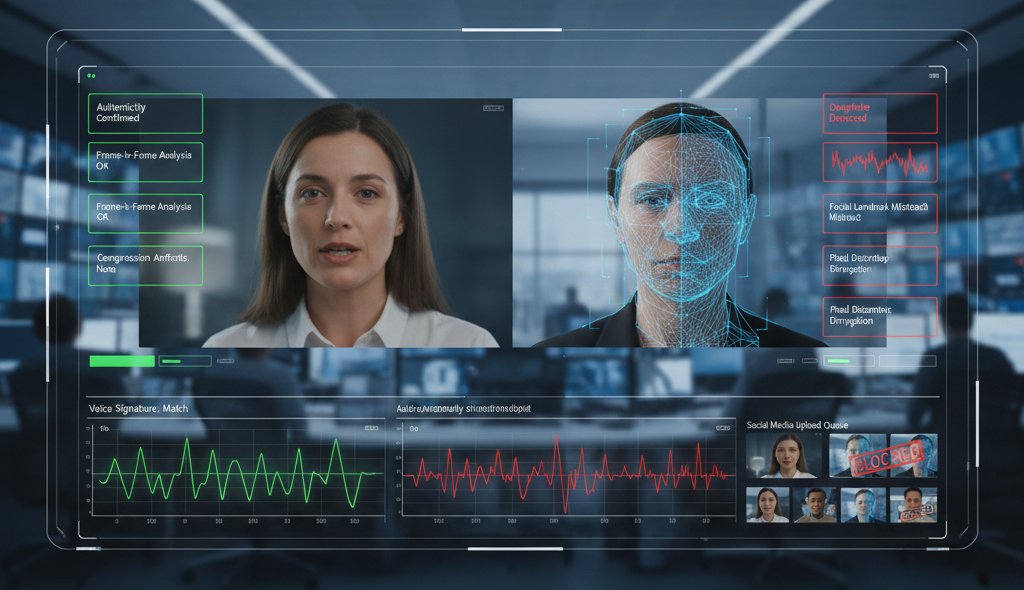
News clips travel fast, and a fake edit can travel faster. You publish on tight deadlines, so small lies can slip in. Deepfakes can swap faces, change words, and copy real voices. That can hurt trust, trigger panic, and stain your brand. You need checks that spot odd pixels, audio cuts, and timing gaps. Media deepfake detection helps you flag risky footage before it goes live. You also protect archives, interviews, and breaking updates from quiet tampering. With the right workflow, you review faster without killing creativity. Your audience stays calm because your content stays real.
Deepfake risks for media companies
Deepfakes hit media teams at the worst possible moment. They look “good enough,” and they spread before the checks finish. That is why deepfake detection for media is now newsroom safety.
Fake breaking news clips
A fake “breaking” clip is made to trip your panic switch. It may show flames, crowds, and shaky camera work, by design. The faker will add sirens and a fake timestamp, to create urgency. Also, they may paste a logo or TV-style banner. Editors see it and think, “We can’t miss this.” Then the lie gets published with your brand attached.
Clues are often small, but they still tell the whole story. Signs are cropped out, and shadows feel off. However, faces look fine at first glance. That “almost real” look is the trap. This is where video and image deepfake detection becomes important.
Newsroom risks
Deadline pressure makes smart people take shortcuts. A desk may skip a second source because the clock is loud. Also, weak verification gates show up when checks are skipped on busy days.
Reputation damage is fast, and it sticks around. A false clip gets shared with your logo, not the faker’s. Thus, newsrooms face an onslaught of AI-manipulated content with campaigns that sync voice cloning, fake video, and bot networks.
Political deepfake speeches and election-interference footage
Politics is a deepfake magnet because outrage travels. A speech can be tweaked to add one ugly sentence. Or it can be fully invented with matching lips.
Some reports say a January 2024 robocall sounded like President Biden. The call urged Democrats not to vote in a primary, and it was AI-made. That shows how one clip can try to steer real turnout.
Voice-cloned anchors and synthetic interview audio splices
Voice cloning is brutal for media brands. It steals trust that was built by familiar voices over many years. A scammer can copy an anchor’s tone from old shows.
Synthetic interview splices are sneakier, because edits hide in plain sound. A bad actor can stitch real answers into one fake quote. Cuts hide under laughter, coughs, or crowd noise in the background. The waveform looks normal, so humans miss it on quick listens.
Tampered UGC videos with spoofed sources and edited metadata
UGC is often the first look at a big event. That makes it valuable and risky for a producer. A clip can be real, but filmed months earlier in another city, or it can be edited and then posted with a false story.
Metadata is not a safety net anymore for most systems. Timestamps can be rewritten, and GPS tags can vanish with one export step. Heavy compression wipes traces too, especially after multiple re-uploads. So you need steps and logs, not just gut feelings.
A good habit is to ask for the original upload link. Then save screenshots of the page, before it gets deleted. Check if the username, date, and caption match other posts. Also look for sudden jumps in resolution, which can signal edits.
Key methods and techniques used in deepfake detection for media companies
Deepfake detection works best as layers, not one magic button. You stack provenance, forensics, and reporting until the story holds.
Conclusion
Deepfakes now move faster than checks, so your guardrails must stay sharp. You keep trust by slowing the rush, even on wild days. Simple proof steps, like source logs, help you spot tricks early. Media deepfake detection works best when it fits your daily workflow. You train staff, tune tools, and keep receipts for every clip. Your name stays clean, even when fakes flood feeds.
Ready to experience & accerlate your Investigations?
Experience the speed, simplicity, and power of our AI-powered Investiagtion platform.
Tell us a bit about your environment & requirements, and we’ll set up a demo to showcase our technology.