
How Should Investigators Interpret Audio Deepfake Detection Results?
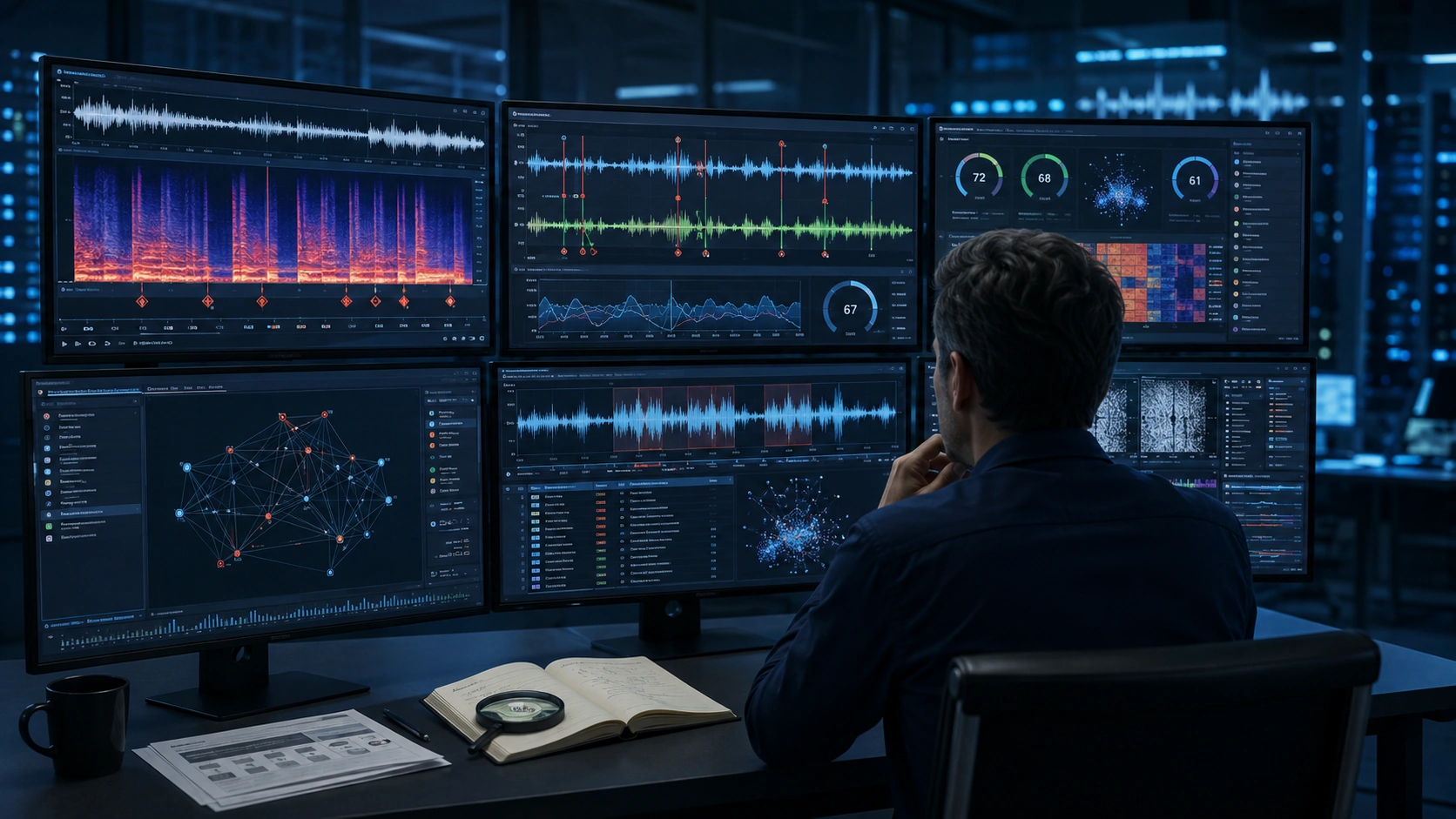
Audio deepfake detection can help investigators identify recordings that contain signs of synthetic speech, voice manipulation, splicing, or other forms of audio alteration. However, receiving a detection result is only one stage of the investigation.
A confidence score, suspicious timestamp, spectral anomaly, or voice inconsistency does not automatically establish that an entire recording is fake. Investigators must understand what the result represents, evaluate the quality of the audio, review supporting indicators, compare the findings with the wider case context, and document any limitations.
This is particularly important when audio evidence may influence operational, investigative, or forensic decisions. The purpose of audio deepfake detection results is to provide technical information that supports human analysis rather than replace it.
What Do Audio Deepfake Detection Results Actually Mean?
Audio deepfake detection results provide an assessment of whether technical characteristics within a recording are consistent with synthetic or manipulated speech. Investigators should evaluate the confidence score, suspicious regions, acoustic indicators, recording quality, and stated limitations together rather than treating a single output as absolute proof.
The meaning of a result can vary depending on the detection system, the recording quality, the type of suspected manipulation, and the amount of usable audio available for analysis.
For this reason, investigators should first understand exactly what the system has evaluated before interpreting the final result.
What Information Should an Audio Deepfake Detection Result Include?
A useful result should explain more than whether a recording has been classified as suspicious.
Investigators may need to review several elements:
| Result element | What investigators should understand |
|---|---|
| Confidence score | Indicates the strength of the system's assessment |
| Suspicious timestamps | Identifies sections of the recording that require closer review |
| Acoustic indicators | Shows technical characteristics associated with possible manipulation |
| Voice consistency | Highlights whether speaker characteristics remain stable |
| Spectral observations | Identifies unusual patterns in the frequency representation of the audio |
| Recording-quality assessment | Explains whether noise, compression, or other conditions may affect analysis |
| Detected limitations | States factors that reduce the strength of the conclusion |
| Analyst status | Indicates whether further human review or escalation is required |
A result that provides only a single percentage without supporting evidence may be difficult to interpret responsibly.
Investigators should be able to understand why the recording was flagged and which parts of the media contributed to the assessment.
How Should Investigators Interpret a Deepfake Audio Confidence Score?
A confidence score should be treated as an analytical indicator rather than a statement of certainty.
For example, a high confidence score does not automatically mean that the recording has been legally or forensically proven to be synthetic. It indicates that the analysed audio contains characteristics that the detection system considers strongly associated with the identified category.
The interpretation of a confidence score should consider:
- The model that generated the score
- The quality and duration of the recording
- The number of usable speech segments
- Background noise
- Audio compression
- Multiple speakers
- Recording or transmission channels
- Whether the audio has been edited
- Whether supporting technical indicators are present
Investigators should also avoid assuming that confidence scores from different detection tools have identical meanings.
A score produced by one system may not be directly comparable with a score generated by another platform because the underlying models, thresholds, and evaluation methods may differ.
Does a High Confidence Score Prove That Audio Is Fake?
No.
A high confidence score can strengthen the technical basis for further review, but it should not be interpreted in isolation.
Investigators should ask:
- Which part of the recording triggered the result?
- Were multiple indicators detected?
- Could the recording conditions explain the anomaly?
- Is the original audio available?
- Has the recording been compressed or re-recorded?
- Does the surrounding case evidence support or contradict the technical finding?
The result should contribute to an evidence-based assessment rather than become the entire assessment.
Which Audio Indicators Should Investigators Review?
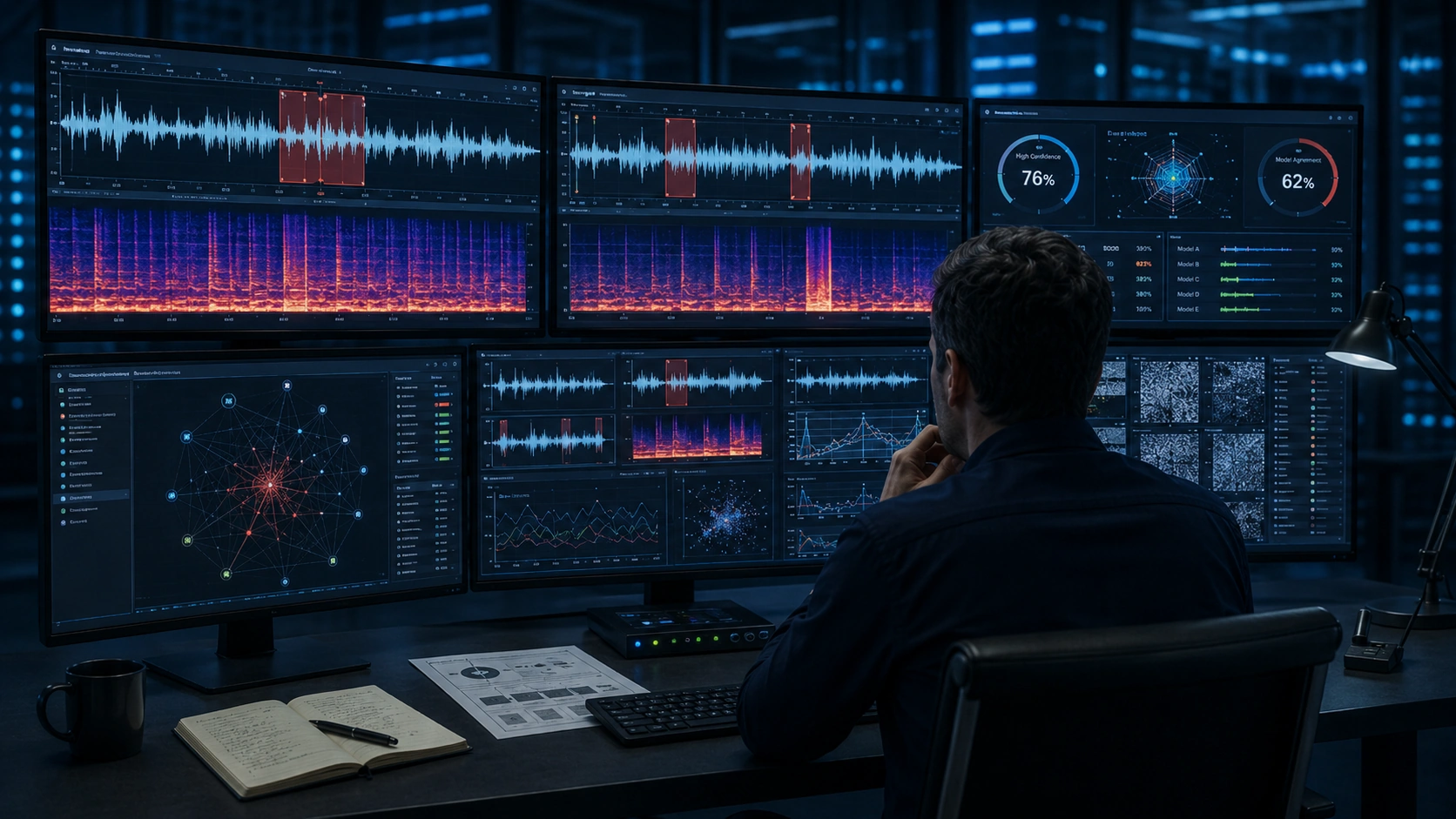
Audio deepfake analysis may examine several characteristics of speech and sound.
Depending on the system, investigators may review indicators involving:
- Frequency behaviour
- Spectrogram patterns
- Pitch variation
- Speech rhythm
- Timing between words
- Voice consistency
- Pronunciation patterns
- Background acoustics
- Abrupt transitions
- Repeated structures
- Synthetic speech characteristics
- Changes between different sections of a recording
These indicators may help identify portions of audio that require additional examination.
An audio deepfake detection system can analyse technical characteristics that may be difficult to identify through listening alone.
No single acoustic anomaly should automatically establish manipulation. Natural speech, poor recording equipment, transmission channels, compression, and editing can all create unusual patterns.
The strongest interpretation comes from reviewing multiple indicators together.
How Does an Audio Deepfake Detection Tool Produce These Results?
Understanding how an audio deepfake detection tool analyses a recording can help investigators interpret why particular segments were flagged.
Detection systems may examine relationships between acoustic and speech characteristics across a recording rather than relying on one visible or audible clue.
Analysis may involve:
- Examining frequency distributions
- Reviewing spectral patterns
- Comparing characteristics across speech segments
- Identifying irregular timing
- Evaluating voice consistency
- Detecting unusual transitions
- Assessing characteristics associated with synthetic generation
The objective is not simply to determine whether a voice sounds unusual.
Modern synthetic speech can sound natural to a human listener. Technical analysis therefore looks for patterns that may remain even when the recording appears convincing.
Why Should Investigators Review Suspicious Timestamps?
A recording may not be manipulated from beginning to end.
For example, a genuine recording could contain:
- An inserted sentence
- A replaced word
- A synthetic voice segment
- Audio from another recording
- Edited pauses
- Spliced conversations
Suspicious timestamps allow investigators to focus on the specific regions where technical anomalies were detected.
This can help teams compare those sections with:
- The surrounding audio
- Original recordings
- Related communications
- Reference voice samples
- Transcripts
- Events described in the recording
Timestamp-level findings also make the final report easier to review because investigators can identify the exact portions that contributed to the assessment.
How Can Recording Quality Affect Audio Deepfake Detection Results?
Recording quality can significantly affect the amount of technical information available for analysis.
Investigators often receive audio that has passed through:
- Telephone networks
- Messaging applications
- Social-media platforms
- Voice-recording applications
- Video-conferencing platforms
- Screen recordings
- Audio editors
- Multiple downloads and uploads
Each stage may change the recording.
Common quality issues include:
- Codec compression
- Background noise
- Echo
- Low microphone quality
- Re-recording
- Noise cancellation
- Voice enhancement
- Automatic gain adjustment
- Multiple speakers
- Very short speech segments
These conditions may remove useful signals, introduce new artifacts, or make genuine speech appear technically unusual.
Investigators should therefore document the recording condition before interpreting the detection result.
Why Is the Original Audio File Important?
The original recording generally provides more technical information than a forwarded, compressed, or re-recorded copy.
Where possible, investigators should request:
- The original file
- Original filename
- Source device information
- Creation or recording time
- Transfer history
- Related messages
- Information about whether the media was edited or converted
A cryptographic hash can also be generated to identify the exact file examined.
If the original is unavailable, analysis can still be performed on the available copy, but the limitation should be clearly recorded.
What Can Cause False Positives in Audio Deepfake Detection?
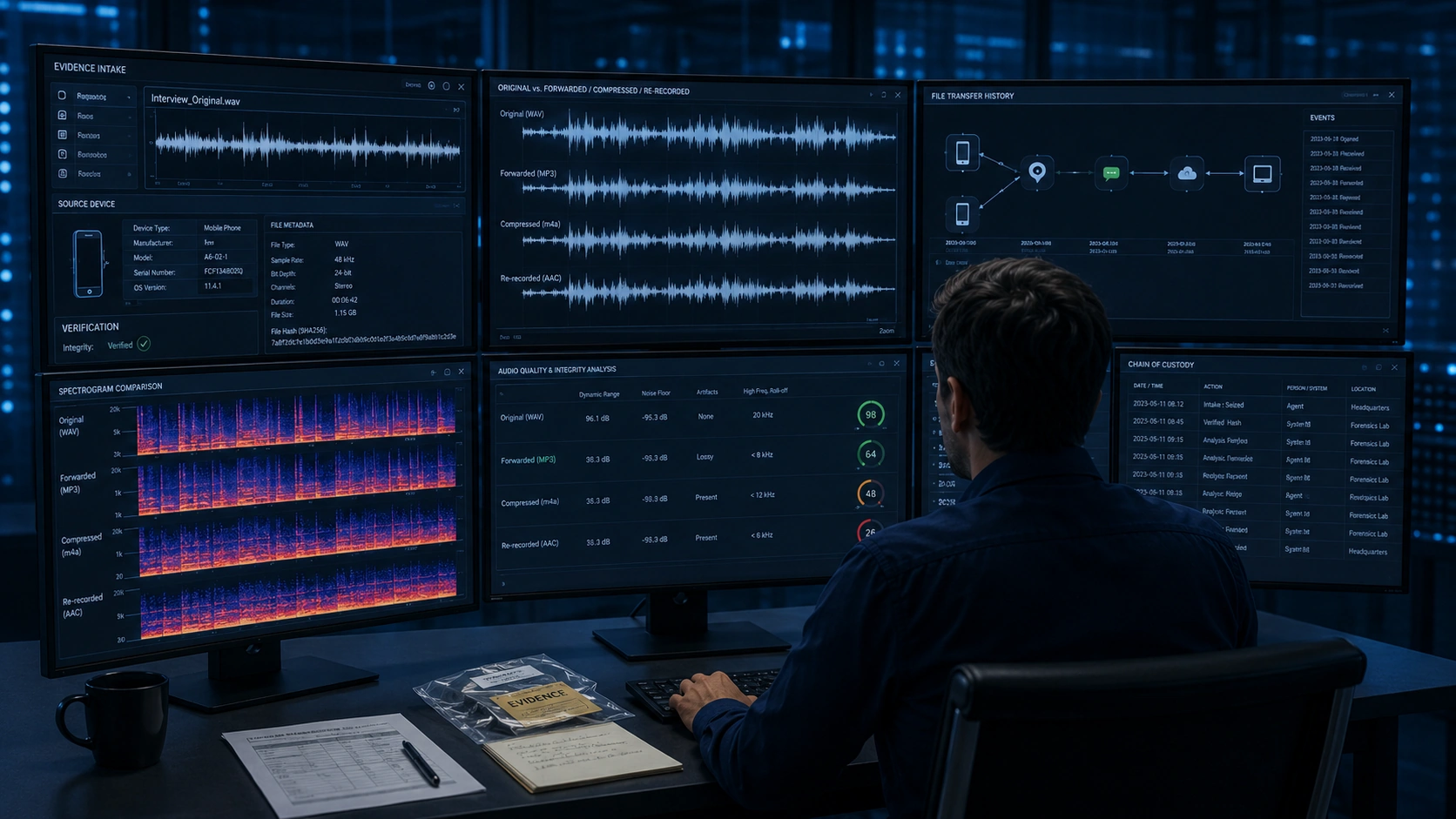
A false positive occurs when genuine or non-synthetic audio produces indicators that resemble characteristics associated with manipulated speech.
Several conditions may contribute to this.
Severe compression
Low-bitrate audio may remove or distort speech characteristics used during analysis.
Poor microphone quality
Low-quality microphones can introduce frequency distortion, noise, clipping, and irregularities.
Noise suppression
Artificial noise-reduction systems may alter natural speech characteristics.
Voice enhancement
Applications that automatically improve voice clarity can change the acoustic properties of a recording.
Re-recorded audio
Playing a recording through a speaker and recording it again introduces room acoustics, microphone characteristics, and additional compression.
Multiple speakers
Overlapping voices can make speaker and acoustic analysis more difficult.
Short recordings
Very limited speech may not provide enough information for a stable assessment.
Edited genuine recordings
A real human recording may have been cut, spliced, filtered, or processed without containing synthetic speech.
These factors are why human review and clearly documented limitations are important.
Can Genuine Audio Still Be Manipulated?
Yes.
Not every manipulated recording is a deepfake.
Investigators may encounter genuine human speech that has been altered through:
- Cutting
- Reordering
- Splicing
- Removing words
- Combining separate recordings
- Changing playback speed
- Adding background sounds
- Applying filters
- Inserting genuine speech from another context
A detector focused on synthetic speech may not answer every question about conventional audio editing.
Investigators should therefore distinguish:
- 1. Synthetic or AI-generated speech
- 2. Manipulated genuine audio
- 3. Contextually misleading authentic audio
A recording may be technically authentic while still being used in a misleading way.
When Should an Audio Deepfake Result Be Considered Inconclusive?
An inconclusive result should be used when the available recording does not support a sufficiently reliable classification.
This may occur when:
- The recording is extremely short
- Background noise dominates the speech
- Compression is severe
- The original file is unavailable
- Multiple speakers overlap
- Important sections are missing
- The audio has been repeatedly processed
- Technical indicators conflict
- Reference material is inadequate
- The recording has undergone several transformations
An inconclusive result should not automatically be interpreted as genuine audio.
It means that the available evidence does not support a stronger technical conclusion.
Investigators should identify what additional material may improve the assessment, such as:
- The original recording
- A longer version
- A cleaner copy
- Another recording of the same event
- Verified reference samples
- Related video or communication evidence
Why Is Human Review Important After Audio Deepfake Detection?
Automated detection can identify technical indicators efficiently, but investigators must interpret those findings within the wider case.
Human review is important because:
- Technical anomalies may have legitimate explanations
- The recording context may contradict the automated result
- Multiple indicators may need to be compared
- Low-quality audio may reduce confidence
- Speaker similarity does not establish identity
- Synthetic speech detection does not establish attribution
- A suspicious segment may represent only part of the recording
The analyst should understand both the evidence supporting the result and the limitations that prevent a stronger conclusion.
High-impact investigative decisions should not depend on a detection score alone.
Does Voice Similarity Confirm Speaker Identity?
No.
A recording may resemble a known person, but voice similarity alone should not be treated as definitive identity confirmation.
Speech can vary because of:
- Recording equipment
- Health
- Emotion
- Background noise
- Language
- Accent
- Speaking style
- Telephone transmission
- Compression
- Intentional voice modification
Synthetic voice technology can also imitate characteristics of a real speaker.
Identity assessment and deepfake detection therefore address related but different questions.
Does Detecting a Deepfake Identify Who Created It?
No.
Audio authentication and attribution should remain separate.
A finding that audio contains synthetic or manipulated characteristics does not independently establish:
- Who generated it
- Which application created it
- Who distributed it
- Who controlled the associated account
- Whether the sender created the recording
- Why the recording was created
- Who should be held responsible
Attribution may require additional evidence involving devices, accounts, communication records, platform information, payment trails, network records, or other investigative material.
How Should Audio Detection Results Be Used in a Digital Investigation?
Audio analysis should be integrated into the wider evidence-handling process.
Where a recording may be relevant to an investigation, teams should consider:
- Preserving the original file
- Recording the source
- Generating a file hash
- Documenting the transfer history
- Identifying suspicious timestamps
- Recording technical findings
- Comparing related communications
- Reviewing other available media
- Documenting analytical limitations
- Preserving the final report
The role of audio deepfakes in digital forensics extends beyond detecting synthetic speech. Investigators must also preserve evidence integrity and explain how conclusions were reached.
How Can Other Evidence Help Interpret an Audio Deepfake Result?
Audio should rarely be examined without considering the information surrounding it.
Supporting evidence may include:
- Messages accompanying the recording
- Call logs
- Device information
- Video footage
- Images
- Account activity
- Witness statements
- Communication timelines
- Verified recordings of the claimed speaker
- Operational records
For example, a suspicious voice recording may claim that an official issued an instruction at a particular time. Investigators can compare that claim with communication logs, location information, verified channels, or other recordings.
A technical finding becomes more useful when it is considered alongside independent evidence.
How Does Audio Analysis Fit Into Broader Deepfake Detection?
Audio is one part of synthetic-media investigation.
A case may include:
- Deepfake video
- Synthetic speech
- Manipulated images
- Edited documents
- Impersonated accounts
Broader deepfake detection methods can help investigators examine these media types together when an incident involves more than one form of manipulated content.
Cross-media review may reveal contradictions that are not obvious when each file is analysed separately.
For example, the audio may appear suspicious while the associated video contains additional manipulation indicators, or a genuine voice recording may have been placed over unrelated footage.
What Should an Audio Deepfake Analysis Report Contain?
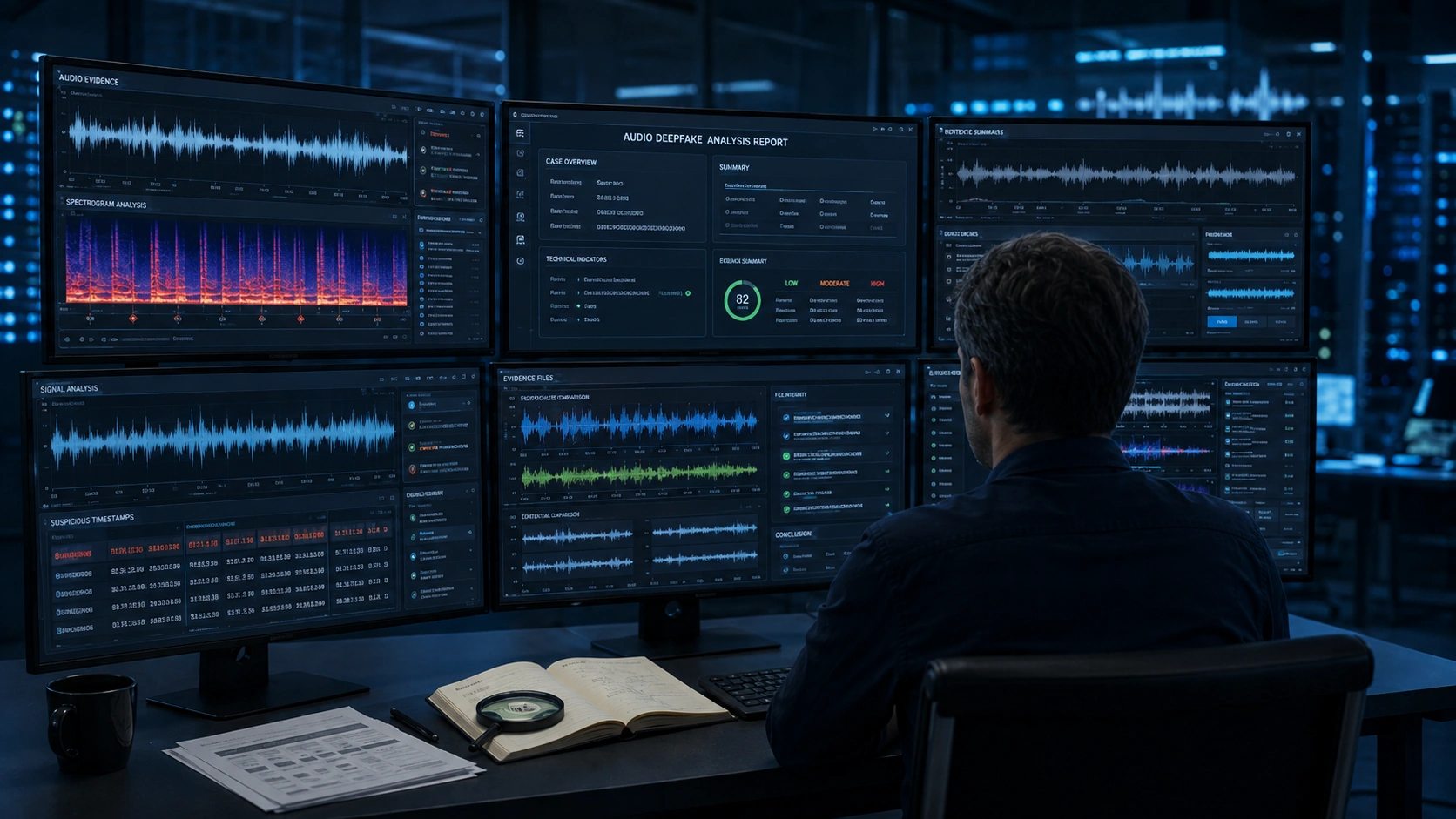
A structured report should make the findings understandable to investigators and reviewers.
| Report component | Purpose |
|---|---|
| File identification | Records the exact audio examined |
| Evidence source | Documents where the recording came from |
| File integrity information | Records hashes and preservation details |
| Recording-quality assessment | Describes noise, compression, and other limitations |
| Suspicious timestamps | Identifies sections requiring closer attention |
| Technical indicators | Explains acoustic or spectral findings |
| Confidence assessment | Communicates the strength of the technical result |
| Contextual comparison | Relates the audio to other case information |
| Limitations | Explains what could not be established |
| Analyst conclusion | Summarises the overall interpretation |
| Recommended action | Identifies further evidence or specialist review that may be required |
The report should avoid presenting technical confidence as absolute certainty.
It should also clearly distinguish between findings about the recording and conclusions about the identity or responsibility of individuals connected to the case.
When Should Audio Be Escalated for Specialist Review?
Further analysis may be appropriate when:
- The result is inconclusive
- The recording may influence a high-impact decision
- The audio is severely degraded
- Multiple technical indicators conflict
- The original file is unavailable
- The recording contains several speakers
- Attribution is being considered
- The media may become formal evidence
- Audio is connected to other suspicious video or images
- Several recordings appear related to the same incident
Specialist review may involve audio-forensics personnel, digital-forensics teams, cybercrime investigators, or other trained analysts depending on the case.
Conclusion
Audio deepfake detection results should be interpreted as part of a broader investigative assessment rather than as a simple real-or-fake verdict.
Investigators should understand what the confidence score represents, identify the technical indicators behind the result, review suspicious timestamps, evaluate recording quality, consider potential false positives, and recognize when the evidence remains inconclusive.
Human review is essential because technical findings must be evaluated alongside the source of the recording, surrounding communications, related evidence, and known limitations.
By combining detection technology with structured evidence handling and informed analyst review, investigators can use audio deepfake findings more responsibly without treating automated outputs as unquestionable proof.
Frequently Asked Questions
Ready to experience & accerlate your Investigations?
Experience the speed, simplicity, and power of our AI-powered Investiagtion platform.
Tell us a bit about your environment & requirements, and we’ll set up a demo to showcase our technology.