
Deepfake Detection vs. Identity Verification: Which Does Your Organization Need?
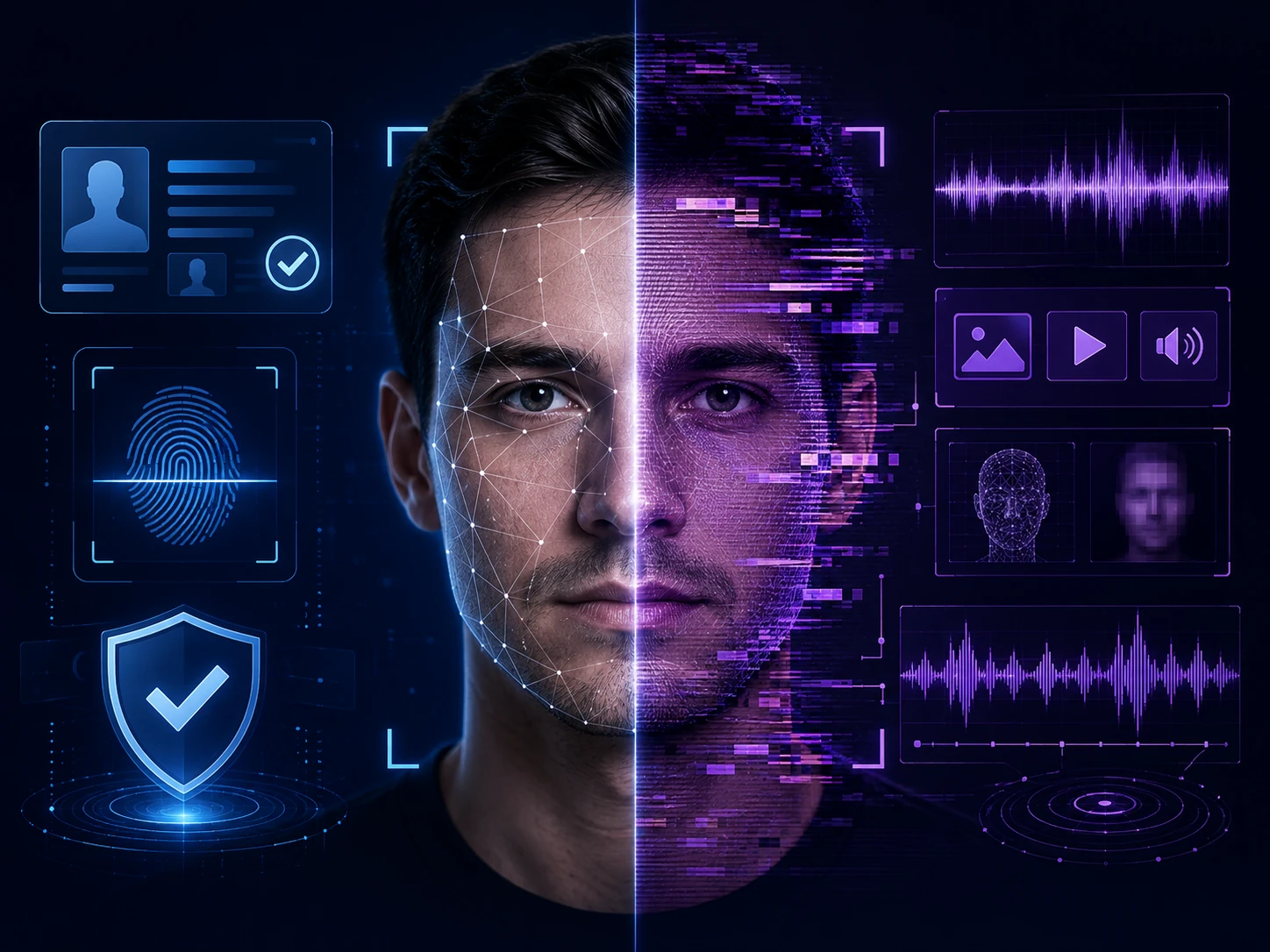
Deepfake detection and identity verification address different trust questions. Identity verification is primarily used to determine whether a person is who they claim to be, while deepfake detection examines digital media for signs of synthetic generation or manipulation. An organization may need one technology or both depending on whether its main concern is identity assurance, media authenticity, or a workflow where the two risks overlap.
Understanding that distinction is important because the technologies are related but not interchangeable. Treating them as substitutes can leave gaps in fraud prevention, onboarding, investigations, and other digital-trust workflows.
What Is the Difference Between Deepfake Detection and Identity Verification?
The simplest distinction is the question each technology is designed to answer.
Identity verification asks: “Is this person who they claim to be?”
Deepfake detection asks: “Does this audio, video, or image show signs of synthetic generation or manipulation?”
The two questions can appear in the same workflow, but they are not the same problem.
| Area | Identity Verification | Deepfake Detection |
|---|---|---|
| Core question | Is this person who they claim to be? | Does this media show signs of AI generation or manipulation? |
| Typical inputs | Identity documents, selfies, biometrics, account information | Video, audio, images and other supported media |
| Primary purpose | Establish or confirm identity | Assess media authenticity |
| Common workflow | KYC, onboarding, account access, identity proofing | Media review, fraud analysis, investigations |
| Synthetic-media role | Varies by platform and implementation | Central analytical purpose |
| Can it replace the other? | No | No |
This distinction also explains why an organization evaluating deepfake detection vs. identity verification should begin with the problem it is trying to solve rather than the names of the available technologies.
What Does Identity Verification Software Actually Do?
Identity verification software helps an organization establish whether an individual corresponds to a claimed identity.
Exactly how this is done varies by provider, industry and risk level. A verification workflow can combine several types of evidence rather than rely on a single check.
Identity and Document Validation
Identity verification may compare information submitted by a user with information contained in identity documents, trusted data sources or existing customer records.
Depending on the workflow, this can involve passports, driving licences, national identity documents or other credentials.
Facial or Biometric Matching
Some systems compare a live or submitted biometric sample against a reference associated with the claimed identity.
The objective is identity matching rather than determining the authenticity of every piece of media that may exist outside the verification process.
Liveness and Session Checks
Identity-verification platforms may also use liveness or anti-spoofing controls to determine whether a genuine person appears to be present during a verification session.
The exact methods and capabilities vary across products, so liveness, identity matching and dedicated deepfake analysis should not automatically be treated as identical functions.
Organizations examining this area in more detail can also consider how deepfake risks affect modern identity verification.
KYC and Digital Onboarding
Identity verification is particularly relevant to workflows where organizations must establish who they are dealing with.
Examples include:
- customer onboarding;
- account creation;
- KYC processes;
- regulated access;
- customer account recovery; and
- high-risk digital transactions.
In these cases, identity assurance is the primary objective.
What Does Deepfake Detection Software Actually Analyze?
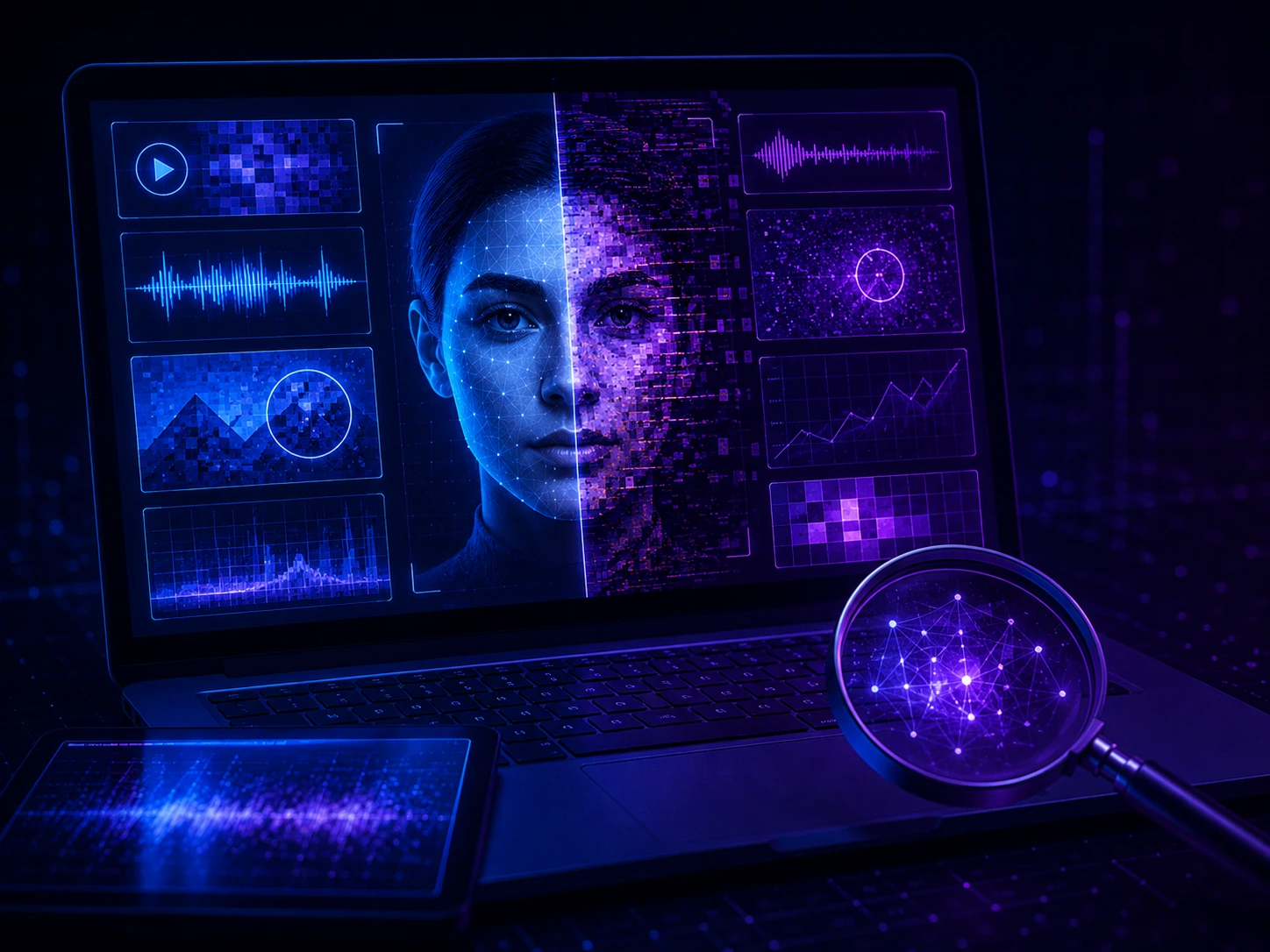
Deepfake detection focuses on the media itself.
Rather than determining whether a person is legally or operationally the claimed identity, deepfake detection examines supported media for indicators that may be associated with AI generation, synthetic modification or manipulation.
Organizations exploring multimodal media authenticity analysis may encounter different analytical approaches for video, audio and image content.
Video Deepfake Analysis
A video can contain different forms of manipulation, including synthetic faces, face replacement, reenactment or other AI-generated visual changes.
Deepfake detection systems may examine signals across frames, temporal behaviour, facial regions or other visual characteristics. The specific methods depend on the technology being used.
AI-Generated and Manipulated Images
Still images can also be generated or altered with AI.
Media analysis may therefore look for characteristics associated with synthetic generation or manipulation rather than relying only on whether an image appears realistic to a human reviewer.
Synthetic and Cloned Audio
Audio deepfakes can imitate a person's voice or create speech that was never spoken by the represented individual.
Dedicated audio analysis focuses on signals within the recording that may help assess whether the content is synthetic or manipulated.
Cross-Media and Forensic Indicators
In some environments, the concern extends beyond one face or one voice.
Investigators, fraud teams and security analysts may need to understand the authenticity of a complete media file and the evidence available to support further review.
That is a different objective from confirming a customer's identity during an onboarding session.
Where Do Deepfake Detection and Identity Verification Overlap?
The technologies overlap when identity assurance depends on media that itself could be manipulated.
A video KYC session is a simple example. An organization may need to determine whether the participant corresponds to a claimed identity while also considering whether the video, image or voice presented during the process has been synthetically altered.
Potential overlap can occur in:
- remote customer onboarding;
- video KYC;
- submitted identity images;
- biometric verification;
- account recovery;
- voice-based support interactions; and
- fraud investigations involving identity media.
These scenarios create two separate questions.
First:
Does the identity match?
Second:
Can the media being used in that decision be trusted?
Organizations dealing with digital onboarding can examine these synthetic identity and KYC manipulation risks in more depth.
What Problems Does Identity Verification Solve That Deepfake Detection Does Not?
Deepfake detection does not replace the core identity-assurance functions of an identity-verification platform.
Establishing a Claimed Identity
Analyzing an image for manipulation does not by itself establish who the person in that image is.
An organization may still need identity records, credentials, biometric comparisons or other verification controls.
Matching a Person Against Identity Information
Identity verification can help connect an individual with a claimed identity.
Deepfake detection instead focuses on the authenticity or manipulation characteristics of the media being analyzed.
Validating Identity Credentials
Organizations may need to verify identity data and credentials as part of regulatory, operational or security requirements.
This is broader than deepfake detection.
Supporting KYC and Customer-Onboarding Decisions
KYC processes often involve multiple checks covering identity, risk and compliance.
Deepfake detection can potentially contribute information about synthetic media within such workflows, but it does not replace the wider KYC process.
What Problems Does Deepfake Detection Solve That Identity Verification May Not?
Identity verification is usually centered on establishing or confirming identity. Suspicious media, however, can appear far beyond an identity-verification session.
Analyzing Suspicious Video
An organization may receive a video involving an executive, employee, customer, public figure or other individual without conducting an identity-verification session.
The question may simply be whether the content shows evidence of manipulation.
Examining Synthetic Audio
A suspicious phone recording, voice message or other audio file may require media analysis even when no formal identity-verification process is taking place.
For identity-related workflows specifically, voice deepfake risks in KYC verification demonstrate where voice authenticity and identity assurance can intersect.
Reviewing Manipulated Images
Images used in fraud, impersonation, social engineering or investigations can require authenticity analysis independently of KYC.
Supporting Media Review After an Incident
Security or investigative teams may need to examine media after a suspected fraud attempt, impersonation event or security incident.
In these circumstances, the task is closer to a forensic media verification workflow than conventional identity verification.
Can Deepfake Detection Replace Identity Verification?
No. Deepfake detection and identity verification perform different functions.
A deepfake detector may provide information about whether analyzed media contains indicators of synthetic generation or manipulation. That result does not, by itself, establish that the person represented in the media has a particular verified identity.
If an organization needs to establish who a customer or user is, identity verification remains a separate requirement.
Deepfake detection can instead provide an additional media-authenticity layer where synthetic content is part of the risk being considered.
Can Identity Verification Replace Deepfake Detection?
Not necessarily.
Some identity-verification products include liveness, anti-spoofing or other controls intended to address manipulation within their verification workflow. Capabilities differ significantly between products.
The important distinction is scope.
An identity-verification system may be designed to protect a specific onboarding or authentication process, while a deepfake detection capability may be used to analyze suspicious media originating from many different sources.
Organizations therefore need to examine what a particular system actually analyzes rather than assume that every identity-verification platform provides the same level or type of synthetic-media analysis.
When Might an Organization Need Both Technologies?
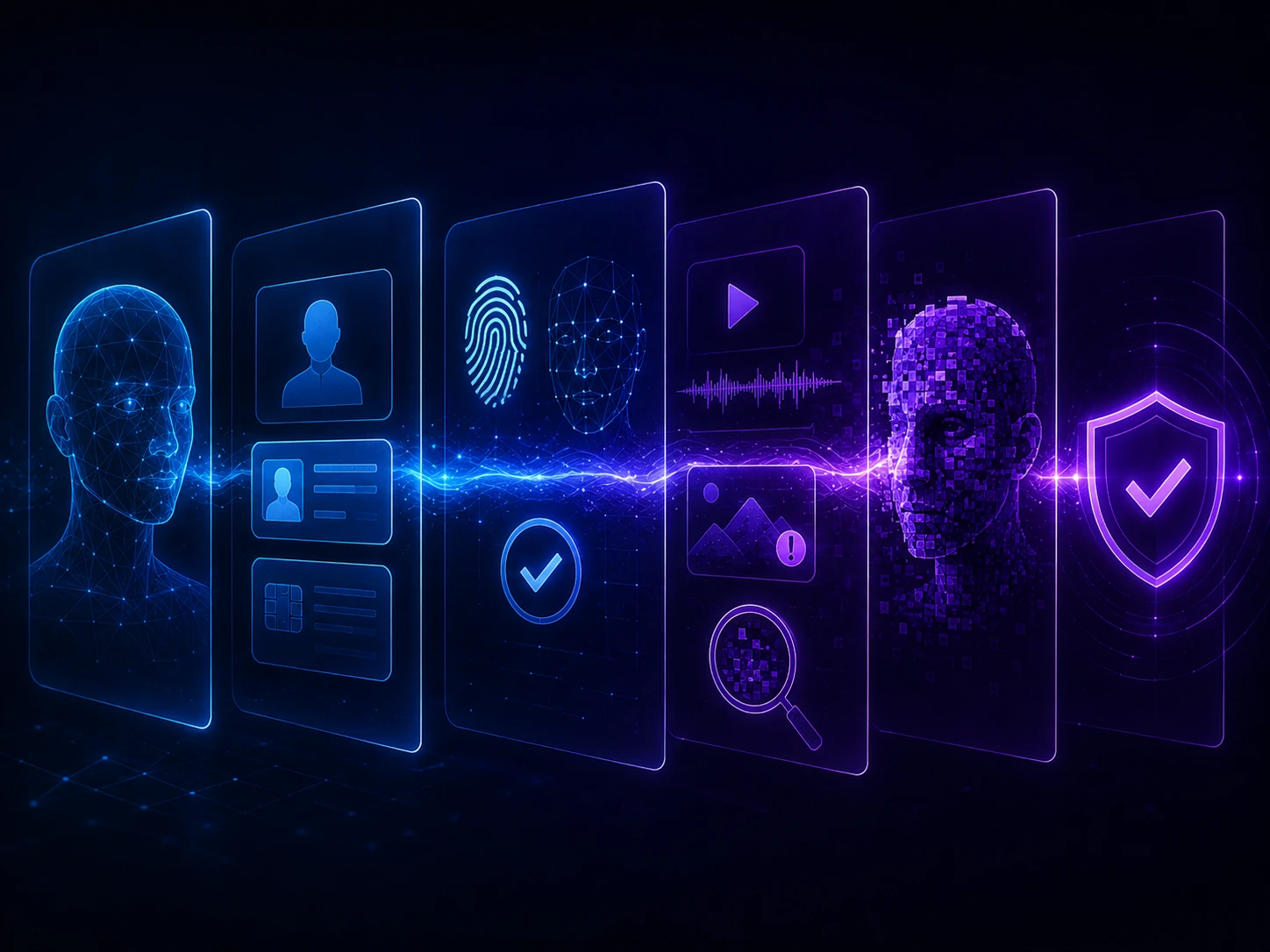
Some workflows contain both an identity risk and a media-authenticity risk.
In those situations, the technologies can be complementary.
High-Risk Digital Onboarding
A digital onboarding process may need to establish the customer's identity while also assessing whether submitted media contains synthetic or manipulated elements.
Video KYC
Video-based KYC can combine identity matching with media-based interactions.
If synthetic video or audio is part of the threat model, organizations may evaluate whether additional media-authenticity analysis is appropriate alongside their identity controls.
Account Recovery and Customer Support
Account recovery can involve knowledge checks, identity information, voice interactions, video calls or other evidence.
Here again, confirming identity and evaluating suspicious media represent related but separate tasks.
Financial Fraud Investigations
After an attempted fraud, investigators may need to examine the media used during the incident even if the original identity-verification workflow has already ended.
Executive or Customer Impersonation
A manipulated recording or video may impersonate a known individual without ever passing through a formal customer-verification system.
This is primarily a media-authenticity problem, although other identity and security controls may also be relevant.
Deepfake Detection vs. Identity Verification: Which Should Your Organization Choose?
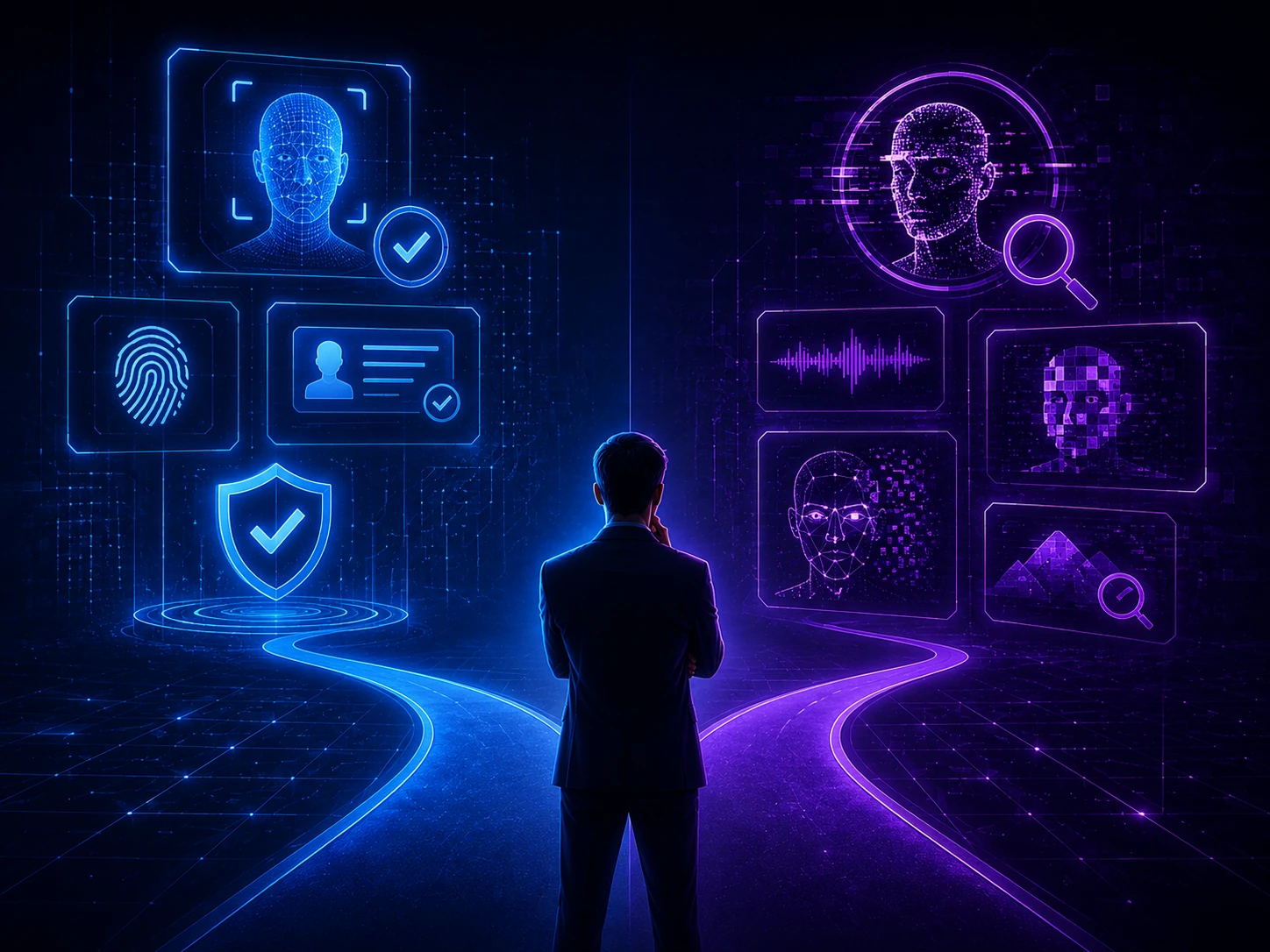
The starting point should be the trust question the organization needs to answer.
| Requirement | Technology to Evaluate |
|---|---|
| Establish whether someone corresponds to a claimed identity | Identity verification |
| Validate identity during customer onboarding | Identity verification |
| Analyze a suspicious video for synthetic manipulation | Deepfake detection |
| Examine suspicious audio for possible synthetic generation | Deepfake detection |
| Assess manipulated or AI-generated images | Deepfake detection |
| Address both identity assurance and synthetic-media risk | Consider both capabilities |
| Analyze suspicious media during an investigation | Deepfake detection |
| Match an individual against identity credentials | Identity verification |
This does not mean that every organization needs both technologies.
A company whose problem is entirely identity assurance may primarily require identity verification. An investigation team reviewing suspicious digital media may primarily require deepfake detection.
The need for both arises where the two trust questions intersect.
What Should Organizations Consider When Comparing Deepfake Detection and Identity Verification?
A useful comparison begins with the operational problem rather than the technology label.
What Decision Is the System Expected to Support?
An identity-verification decision and a media-authenticity decision are not equivalent.
Organizations can first define whether the outcome needs to establish identity, assess media integrity, or contribute evidence to both questions.
What Type of Input Is Being Evaluated?
Identity workflows may involve credentials, user information and biometric inputs.
Deepfake detection focuses on supported digital media such as images, audio and video.
Understanding the input helps clarify which technology category is relevant.
Where Does the Risk Appear?
If the risk exists inside a customer-onboarding or authentication process, identity-verification capabilities may be central.
If suspicious media can arrive through investigations, communications, fraud incidents or external sources, dedicated media analysis may address a broader problem.
Is One Result Being Used as Evidence for Another Decision?
A deepfake detection result should not automatically be interpreted as an identity decision.
Likewise, a successful identity-verification result should not automatically be treated as proof that every associated piece of media is authentic.
Keeping these decisions separate helps organizations interpret results within the correct context.
Could the Technologies Be Complementary?
In some workflows, identity confirmation and media authenticity are both relevant.
The architecture can therefore be layered rather than framed as a choice where one technology must completely replace the other.
What Factors Are Commonly Considered When Evaluating Deepfake Detection Vendors?
Organizations evaluating deepfake detection products may encounter different capabilities, workflows and deployment models. The relevance of each factor depends on the organization's use case and technical environment.
Supported Media Types
Some requirements involve only video, while others involve combinations of video, image and audio.
Understanding which media formats a system is designed to analyze can help determine whether it matches the intended workflow.
Relevant Manipulation Types
Synthetic media is not one single technique.
Evaluation may therefore consider which forms of generated or manipulated content are relevant to the organization's actual threat scenarios.
Result Interpretation
A detection result can be more useful when analysts understand what the system is communicating and how that information should be interpreted.
Organizations may therefore consider how results, indicators and supporting information are presented.
Workflow Integration
Some environments require standalone analysis, while others need integration into an existing security, investigation, fraud or media-processing workflow.
Technical teams can review the available DeepGaze technical capabilities when assessing how a platform could fit into their own architecture.
Deployment and Data Requirements
Organizations can have different requirements around infrastructure, security, data handling and deployment.
These considerations are typically determined by internal technical, compliance and security teams rather than by a universal rule.
Reporting and Review
Where deepfake analysis supports investigations or high-impact decisions, teams may also consider how findings can be reviewed, documented and shared with relevant analysts or decision-makers.
The importance of each factor will vary by environment, which is why vendor evaluation should remain tied to the organization's actual operational requirements.
Conclusion
Deepfake detection and identity verification are connected by a common goal—digital trust—but they solve different problems.
Identity verification focuses on establishing who a person is. Deepfake detection focuses on determining whether digital media shows signs of synthetic generation or manipulation.
One cannot automatically substitute for the other.
For organizations deciding between the two, the most useful starting question is not simply, “Which technology is better?”
It is:
What are we trying to trust—the identity, the media, or both?
Once that question is clear, it becomes much easier to determine whether identity verification, deepfake detection, or a combination of the two fits the organization's requirements.
Frequently Asked Questions
Frequently Asked Questions
Ready to experience & accerlate your Investigations?
Experience the speed, simplicity, and power of our AI-powered Investiagtion platform.
Tell us a bit about your environment & requirements, and we’ll set up a demo to showcase our technology.