
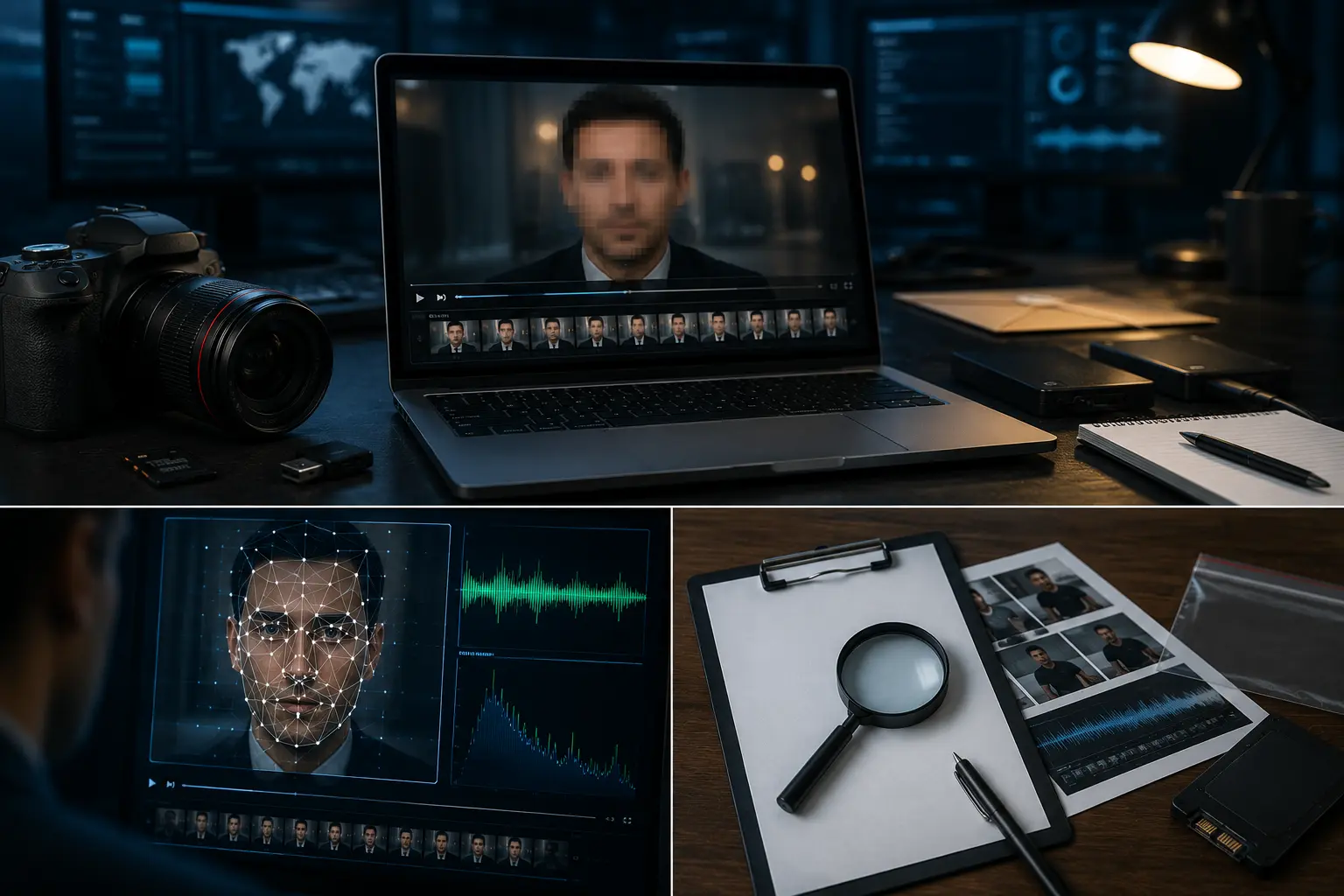
How Do Investigators Verify a Suspected Deepfake Video From Intake to Final Report?
A suspicious video can enter an investigation through a social media post, messaging application, email attachment, surveillance system, news report, or complaint submitted by an affected organization. It may appear to show an executive authorizing a payment, a public official making a statement, a suspect appearing at a location, or an individual participating in a video call.
However, deciding whether the video simply looks real or fake is not enough. A reliable deepfake video investigation requires a structured process that preserves the original file, examines its source and processing history, analyses visual and temporal signals, compares audio with facial movement, reviews supporting evidence, records uncertainty, and produces an explainable final report.
Quick Answer: How Is a Suspected Deepfake Video Investigated?
Investigators verify a suspected deepfake video by preserving the original media, documenting its source, examining metadata and encoding information, analysing visual and frame-to-frame inconsistencies, comparing speech with lip movement, and reviewing contextual evidence. Automated detection can highlight suspicious indicators, but final findings should also consider media quality, processing history, corroborating evidence, stated limitations, and trained analyst review.
What Happens When a Suspicious Video Enters an Investigation?
The first stage is not deepfake detection. It is evidence intake. Investigators must establish what the video is, where it came from, how it was received, and why it is relevant to the case.
Important intake questions include:
- Who submitted or discovered the video?
- Where was it originally published or shared?
- Is the available file an original or a downloaded copy?
- Has it been forwarded through a messaging application?
- Was it cropped, edited, compressed, resized, or screen-recorded?
- Is a longer or higher-quality version available?
- Are related posts, messages, URLs, or account details available?
- What claim is the video being used to support?
These questions help investigators understand both the technical condition of the file and the context in which it is being presented. A video can be technically authentic but shared with a false caption. It may also contain genuine footage with only one manipulated segment.
Investigators who need a broader overview of facial artifacts, lip-sync manipulation, frame inconsistencies, and common detection methods can review the video deepfake detection fundamentals before examining the complete investigation workflow.
Why Must the Original Video Be Preserved?
Preservation protects the integrity of the evidence. Repeatedly editing, exporting, converting, or compressing a file may alter its technical properties and remove information that could support the investigation.
Investigators should preserve the highest-quality version available and conduct analysis on an approved working copy. A basic preservation workflow may include:
- Recording when and how the file was received
- Preserving the original filename and media format
- Creating a cryptographic hash for integrity verification
- Storing the original file in a controlled location
- Creating a verified working copy for examination
- Recording every transfer, access, and analytical action
- Preserving related URLs, messages, screenshots, and account details
The file hash helps demonstrate whether the preserved media changed after collection. The working copy allows analysts to extract frames, inspect metadata, and perform technical analysis without modifying the original evidence.
These practices are especially important in deepfake detection for digital forensics labs, where repeatability, secure evidence handling, and documented examination procedures are central to the investigation.
How Is the Video’s Source and Processing History Examined?
Investigators next review the technical properties and known processing history of the file. This may help explain whether the video is an original recording, an exported copy, a social media download, or a repeatedly transformed version.
The review may include:
- File format and extension
- Video and audio codecs
- Resolution and aspect ratio
- Frame rate and bitrate
- Creation and modification information
- Editing-software references
- Device details where available
- Export or conversion history
- Compression characteristics
- Missing or inconsistent metadata
Metadata can provide useful clues, but it must be interpreted carefully. Missing metadata does not prove that a video is fake because social platforms, messaging applications, editing software, and file converters may remove or replace metadata during normal processing.
Similarly, intact metadata does not prove that the visible content is genuine. Metadata may be incomplete, altered, copied, or disconnected from the media’s actual history.
Investigators should therefore evaluate both content provenance and deepfake detection. Provenance helps explain where media came from and how it changed, while content-based analysis examines whether the visible or audible material contains manipulation indicators.
How Is an Initial Video Triage Performed?
Initial triage determines whether the file contains enough useful information for deeper analysis. The purpose is not to reach a final conclusion but to understand what types of examination are possible.
Investigators may assess:
- Whether a face is visible
- The size and clarity of the face
- Whether speech is present
- Whether the video contains cuts or scene changes
- Whether audio and video appear synchronized
- Whether motion blur affects important regions
- Whether the clip is long enough for temporal analysis
- Whether only one segment appears suspicious
- Whether the file has undergone heavy compression
- Whether a higher-quality version should be requested
A file may be suitable for detailed analysis, limited but still usable, or insufficient for reliable examination. An insufficient result should not automatically be treated as genuine or manipulated. It means the available file does not contain enough reliable information to support a strong conclusion.
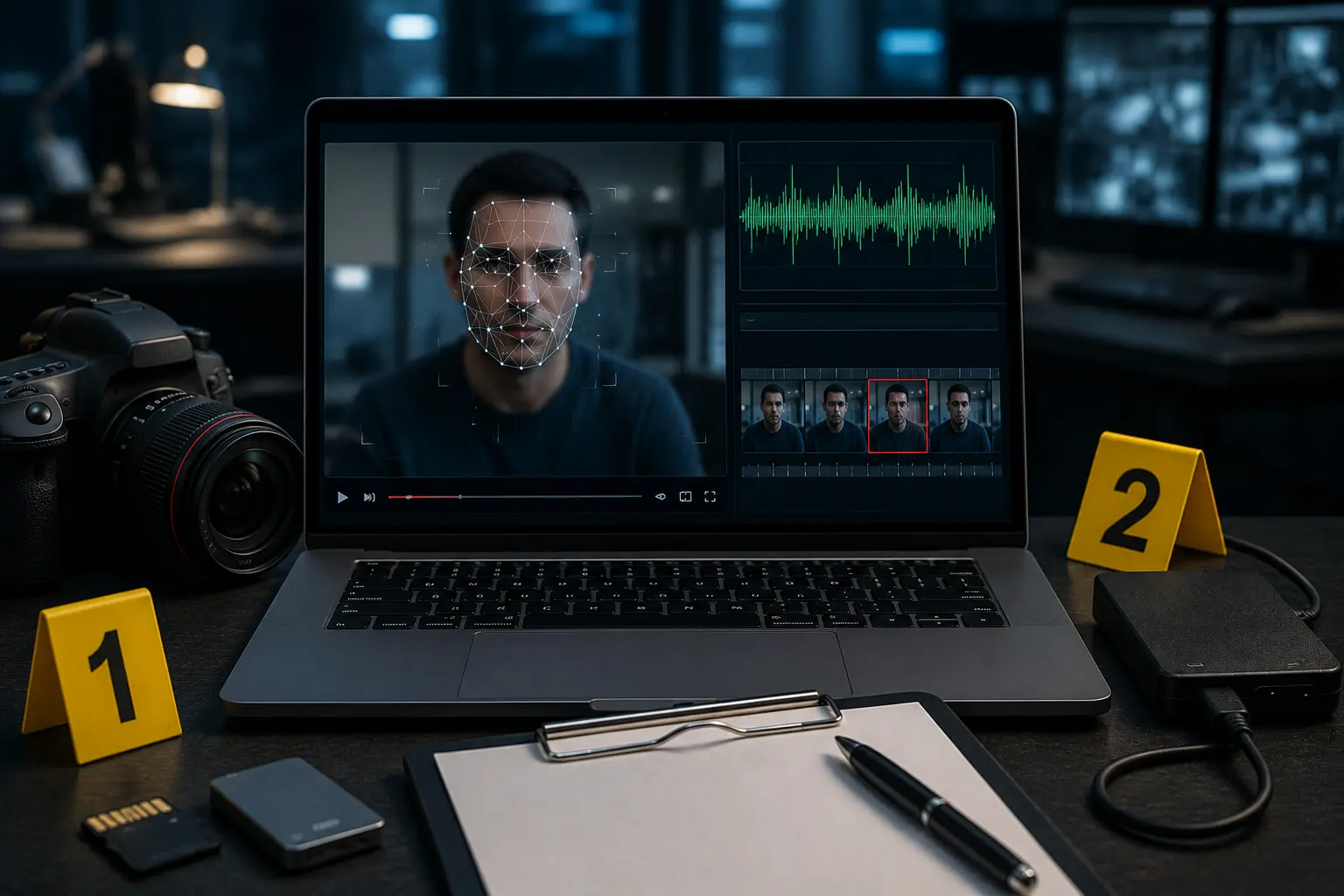
What Visual Indicators Are Examined?
A technical video examination looks beyond simple public warning signs such as unnatural blinking or distorted facial movement. Investigators examine multiple visual regions and behaviours to determine whether the face, body, lighting, and surrounding scene remain consistent.
Facial boundaries may be reviewed around the jawline, hairline, ears, glasses, teeth, neck, and areas covered by facial hair. Face replacement and reenactment techniques can create irregular transitions that become more visible during head movement or changes in expression.
Lighting should also behave consistently across the face and surrounding scene. Investigators may compare the direction of light, facial shadows, reflections in glasses, highlights on the skin, and changes in illumination during movement.
Facial geometry may be examined across multiple frames, including eye alignment, mouth shape, head pose, facial proportions, expression transitions, and coordination between the face and body.
However, a visible edge, blurred region, or unusual shadow is not automatically evidence of a deepfake. Compression, poor lighting, camera limitations, background blur, beauty filters, and conventional editing may create similar visual effects.
How Is Frame-to-Frame Consistency Analysed?
A single video frame may appear convincing while manipulation becomes visible across a sequence. Video deepfakes must maintain consistent facial detail, movement, lighting, and expression over time.
Frame-level analysis may reveal:
- Temporal flickering
- Sudden changes in facial texture
- Unstable facial boundaries
- Teeth changing shape
- Glasses or earrings appearing inconsistent
- Skin detail changing between frames
- Abnormal expression transitions
- Face regions moving differently from the head
- Manipulation limited to specific timestamps
Investigators may extract individual frames or examine short sequences around suspicious moments. This helps determine whether the entire video is affected or whether manipulation appears only within a localised segment.
Modern investigation workflows may combine analyst-led examination with AI-assisted digital forensic analysis to identify frames and segments that require closer review.
How Are Audio and Lip Movement Compared?
A manipulated video may contain genuine visuals with synthetic audio, a synthetic face following genuine audio, or coordinated manipulation across both channels. Investigators therefore compare speech timing with mouth movement and examine whether the audio remains consistent with the visible scene.
The examination may consider:
- Speech timing
- Mouth opening and closing
- Lip shapes during specific spoken sounds
- Delayed or premature mouth movement
- Voice consistency
- Room echo and background acoustics
- Sudden changes in audio quality
- Audio-video synchronization across the complete clip
Repeated or localised timing differences may justify further analysis. However, audio-video mismatch is not automatic proof of malicious manipulation. Legitimate dubbing, translation, editing, network delay, and platform synchronization errors may produce similar effects.
How Do Compression, Cropping, and Re-Encoding Affect the Investigation?
Real-world evidence is often transformed before it reaches an investigator. A video may have been uploaded to a social platform, forwarded through a messaging application, downloaded multiple times, cropped, resized, converted, re-encoded, or screen-recorded.
These transformations may:
- Remove or replace metadata
- Reduce facial detail
- Change frame timing
- Alter audio quality
- Introduce compression artifacts
- Remove background context
- Create new file structures
- Weaken some manipulation indicators
Compression may weaken certain forensic indicators while also producing block patterns that resemble manipulation. Cropping may remove useful lighting or environmental references. Screen recording may replace the original file structure with a new capture of the displayed content.
The original file is preferable because it usually preserves more technical information. However, a transformed copy may still contain useful visual, temporal, audio, or cross-modal indicators.
How Do Investigators Separate Deepfakes From Normal Editing?
Not every edited video is a deepfake, and not every unusual artifact is malicious. Investigators should consider legitimate explanations before attributing an anomaly to AI-generated manipulation.
For example, lip movement mismatch may result from dubbing or synchronization errors. Smoothed facial texture may result from a beauty filter. Compression blocks may come from messaging-app processing. Abrupt transitions may be normal edits, and missing metadata may result from platform stripping.
A reliable assessment should be based on the combined weight of multiple indicators. One visual anomaly should not determine the final conclusion.
How Is the Video Compared With Other Evidence?
A suspected deepfake should not be examined in isolation. Investigators may compare the file with known authentic media, earlier uploads, surveillance footage, official recordings, device information, witness statements, account activity, location evidence, call records, and verified audio samples.
This comparison helps answer questions that technical detection alone cannot resolve. A video may be technically genuine but recorded on a different date than claimed. A real speech may be cut and reordered to create a false meaning. A synthetic face may be placed over otherwise authentic footage.
Content authenticity and contextual accuracy are related but separate questions. Investigators must examine both.
How Are Uncertain or Conflicting Findings Handled?
Not every investigation produces a simple real-or-fake answer. The available evidence may be incomplete, heavily compressed, contradictory, or outside the reliable scope of the analytical process.
A responsible assessment may use categories such as:
- No significant manipulation indicators identified
- Insufficient evidence for a reliable conclusion
- Indicators consistent with possible manipulation
- Multiple indicators support synthetic or manipulated content
When findings remain uncertain, investigators may request the original file, obtain a higher-quality version, compare the video with known authentic media, analyse additional recordings, examine suspicious timestamps separately, or seek a second technical review.
Uncertainty should be documented clearly rather than hidden behind a binary classification.
What Should a Deepfake Investigation Report Contain?
The final report should explain what was examined, how it was examined, what was observed, and what limitations remain. A detection score without supporting explanation provides limited investigative value.
A structured deepfake investigation report may include:
- Case or reference number
- File name and file hash
- Source information
- Date and method of receipt
- Technical media properties
- Tools and software versions used
- Examination steps
- Metadata observations
- Visual findings
- Temporal findings
- Audio-video findings
- Suspicious frames or timestamps
- Confidence interpretation
- Alternative explanations considered
- Analysis limitations
- Analyst observations
- Final assessment
The final document should form part of a wider forensic media verification workflow that preserves technical findings, analyst observations, and clearly stated limitations.
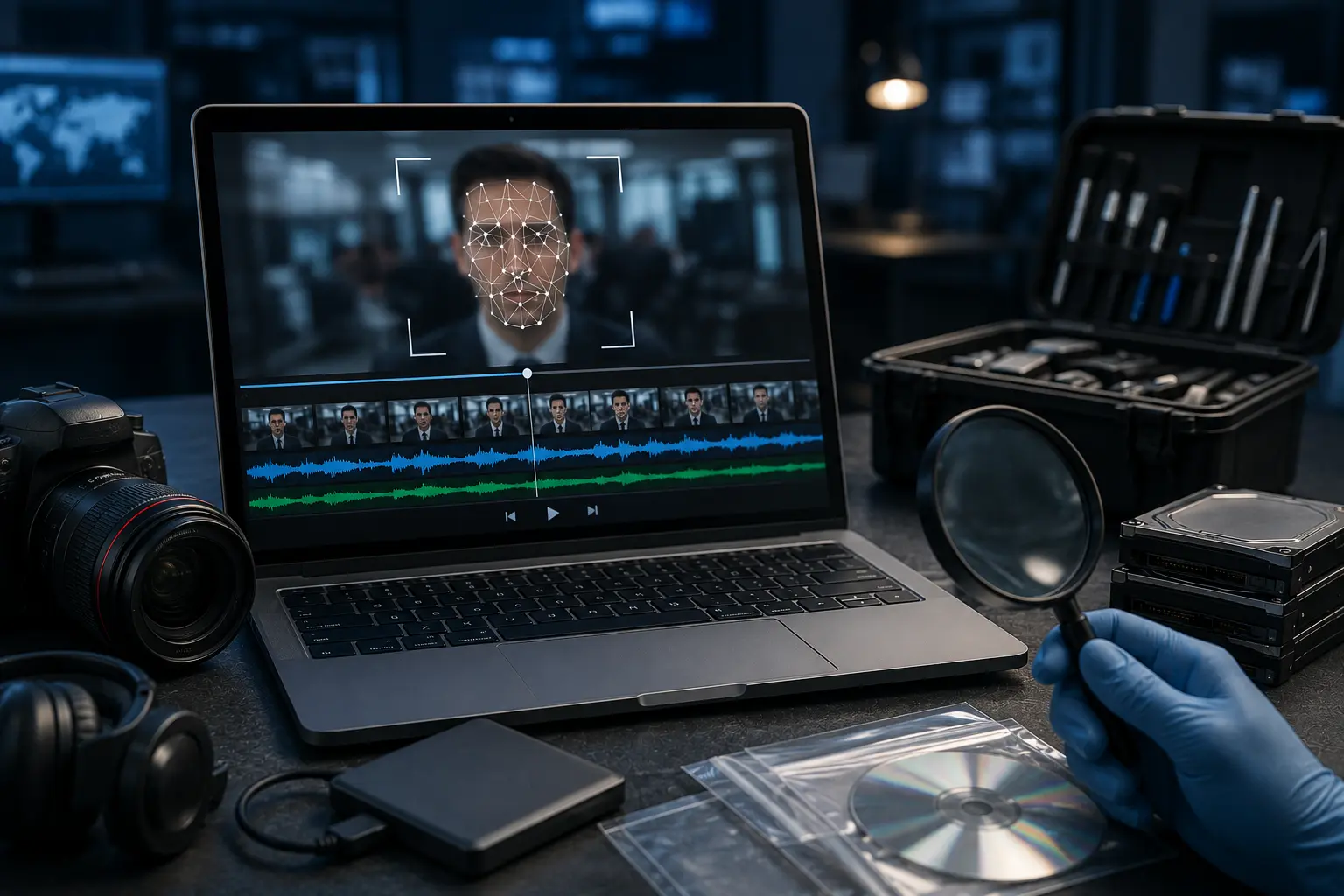
How Does DeepGaze Support Video Investigation Workflows?
Investigating suspicious video requires more than checking one visible artifact or producing a basic fake-or-real label. DeepGaze video deepfake detection technology supports organizations by examining suspicious video, image, and audio content across multiple analytical signals.
Investigating suspicious video requires more than checking one visible artifact or producing a basic fake-or-real label. DeepGaze video deepfake detection technology supports organizations by examining suspicious video, image, and audio content across multiple analytical signals.
The platform supports the technical verification stage of an investigation. Its outputs should be considered alongside evidence integrity, file quality, processing history, contextual information, corroborating evidence, and trained human review.
DeepGaze does not replace chain-of-custody procedures, investigative judgment, or supporting evidence. Instead, it provides a structured way to analyse suspicious media and document the indicators that informed the assessment.
Deepfake Video Investigation Checklist
Before completing a deepfake video investigation, confirm that the investigation team has:
- Preserved the highest-quality available file
- Created a verified working copy
- Recorded the source and transfer history
- Generated and documented a cryptographic file hash
- Reviewed format, codec, resolution, frame rate, and metadata
- Conducted visual and frame-level analysis
- Compared audio with mouth movement
- Considered compression and normal editing artifacts
- Compared the video with supporting evidence
- Recorded conflicting or uncertain indicators
- Stated the limitations of the analysis
- Produced an explainable final report
Conclusion
Real-world deepfake video investigation is not a single automated scan. It is a structured process combining evidence preservation, source examination, visual analysis, temporal review, audio-video comparison, contextual verification, and explainable reporting.
Automated detection can help investigators locate suspicious frames and identify patterns that require closer attention. However, reliable conclusions depend on the quality of the media, its processing history, the consistency of multiple indicators, and the availability of supporting evidence.
The objective is not merely to label a file as genuine or fake. It is to produce a clear and reviewable assessment that explains what was found, what remains uncertain, and how the result should be used within the wider investigation.
Frequently Asked Questions
Ready to experience & accerlate your Investigations?
Experience the speed, simplicity, and power of our AI-powered Investiagtion platform.
Tell us a bit about your environment & requirements, and we’ll set up a demo to showcase our technology.